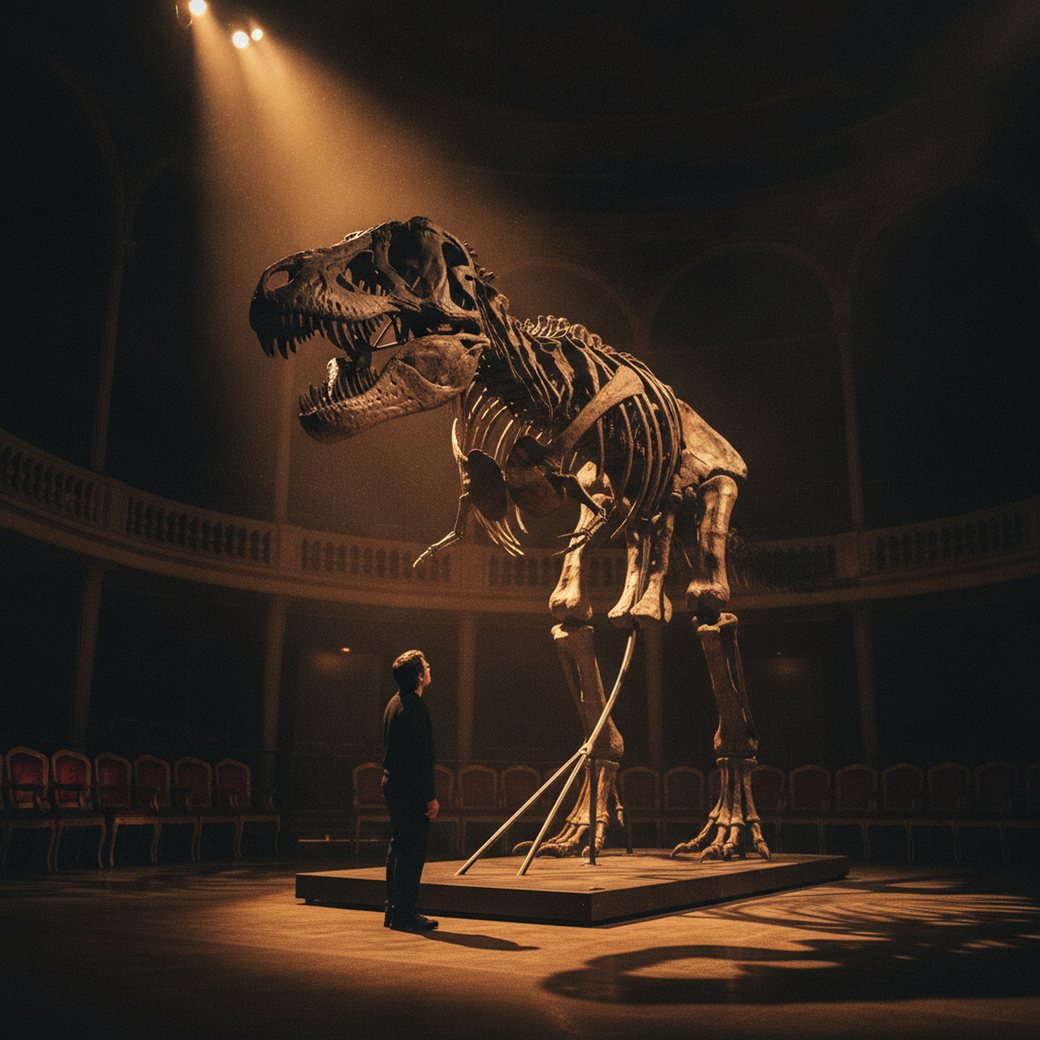
On 14 July 2026, in a hushed room inside Sotheby's Breuer building in New York, a phone rang, a paddle went up, and a 67-million-year-old dinosaur changed hands for $50.1 million. His name is Gus, he is a Tyrannosaurus rex, and he is now the most expensive fossil ever sold at auction. The buyer? Nobody knows. They bid by phone and chose to stay anonymous, which means one of the largest, most complete T. rex skeletons on Earth has just walked out of public life and into a mystery.
This is, on paper, a science story. But look at how it was sold — the theatrical lighting, the celebrity-lot hype, the price tag that outmuscles most Picassos — and it starts to look suspiciously like an art story. So let's do what we do here and treat the dinosaur like a masterpiece for a minute. Because the more you stare at Gus, the harder a very simple question gets: is a dinosaur art?
Meet Gus, the $50 million lizard king
Gus is a genuine monster. According to CNBC, he measures about 38 feet long and 12.5 feet tall, with a skull roughly 54 inches from front to back — one of the largest and most complete T. rex specimens ever pulled out of the ground. He was excavated between 2021 and 2023 on a private ranch in South Dakota, in a dig led by commercial paleontologist Thomas Heitkamp, and named in honour of the late Gary "Gus" Licking, who owned the land where he was found.
The $50.1 million hammer, reported by the Washington Post, sailed past every previous dinosaur record. For scale: "Stan," the T. rex that held the crown before, sold for $31.8 million at Christie's back in 2020. And it isn't only tyrannosaurs — in 2024, a Stegosaurus nicknamed "Apex" went for $44.6 million to hedge-fund billionaire Ken Griffin, who at least did the decent thing and loaned it to the American Museum of Natural History. Gus blew past all of them. Fossil prices, it turns out, have their own bull market.
A painting is worth millions because a person made it. A T. rex is worth millions because, for 67 million years, nobody did.
So — is a dinosaur art?
Here is the honest answer: no, not in the way a Rembrandt is. Nobody made Gus. There is no artist, no intention, no brushstroke — just deep time, luck, and a great deal of sediment. By the textbook definition, a fossil is the opposite of art. It is pure nature, and the only human decision involved was where to point the shovel.
And yet. Walk into the room where he's mounted and every instinct that fires in front of a great sculpture fires here too. The awe of scale. The strange intimacy of standing before something far older and larger than yourself. The way the skull's empty eye socket seems to hold a gaze. We respond to a T. rex skeleton with exactly the machinery we use for a cathedral or a Michelangelo — and that response is real, whether or not a human authored it. As we've argued about negative space, a lot of art's power comes not from what's added but from how emptiness and scale are staged. A mounted skeleton is almost pure staging: bone, shadow, and the dramatic void where a living animal used to be.
The auction house knows this perfectly well. It lit Gus like a Caravaggio, wrote him a name and a backstory, and sold him with the same choreography it uses for a blue-chip painting. In that sense the sale performs a quiet magic trick: it turns a research specimen into a collectible object of contemplation. That's not a scientific transformation. That's an artistic one — and it's the same sleight of hand that let a banana duct-taped to a wall sell for $6.2 million. The object barely matters; the framing does almost all the work.
The part that isn't fun: what science loses
Now the uncomfortable bit, because Gus deserves better than a shrug. When a scientifically important fossil disappears into an anonymous private collection, researchers lose it — possibly forever. The Society of Vertebrate Paleontology, the field's main professional body, has a long-standing position that significant vertebrate fossils belong in accredited museums and public institutions, precisely so scientists can study them and the public can see them. A specimen you can't access is, scientifically, a specimen that doesn't exist.
Their reaction to the Gus sale was blunt. As reported by NPR, the society's president, paleontologist Stuart Sumida, said auction houses like Sotheby's and Christie's are "complicit in removing data from the scientific process." That's the crux: a T. rex isn't just a big impressive thing. It's a 67-million-year-old data set — growth rings in the bone, bite marks, chemistry, disease, the whole biography of an animal. Sold to a stranger who need never show it to anyone, that data can simply switch off. The academic outlet The Conversation put it well: when a T. rex becomes a trophy, science loses a library.
It's worth being fair to the other side, too. Commercial paleontologists point out that many spectacular fossils are found on private land, and that without a market to fund the slow, expensive work of excavation, specimens like Gus might have stayed buried — or eroded away to nothing. That's a genuine argument, not a fig leaf. The problem isn't that money touches fossils; it's that a record-breaking anonymous sale bakes in no guarantee the specimen will ever be studied or seen again.
Trophy, artwork, or research subject?
So which is Gus? The honest answer is that he's being asked to be all three at once, and the three definitions don't get along. To a scientist he's a specimen. To a collector he's the ultimate trophy — the biggest, oldest, most impossible thing money can buy. And to the auction room he's functionally an artwork: a unique, non-reproducible object whose value floats on desire, scarcity and spectacle rather than utility.
That collision is exactly why the story went viral, and why it belongs in a conversation about art at all. It's the same question we keep circling with toys and jokes and stunts — is a plastic monster art, is a banana art, is a fossil art, is a seven-ton glass desk art? Each time, the real answer is that "art" isn't a property baked into the object. It's a decision a culture makes about how to look at something. Point a spotlight, write a label, invite the world to feel awe, and almost anything can be pulled across the line — even a dead lizard the size of a bus. And once the world agrees a thing is priceless, it becomes a target: see our look at France's run of brazen museum heists, where thieves gamble that a 2,500-year-old treasure is worth its weight in scrap gold.
What makes Gus sting a little more than the banana is that there's a loser in the room. Nobody's worse off if a taped banana ends up in a vault. But a T. rex in a vault is a genuine loss — for kids who'll never see it, for scientists who'll never scan it, for all of us who briefly owned a piece of deep time before a phone bidder took it home.
Gus is the extreme end of a pattern that runs all through this journal: objects nobody classified as art until the price said otherwise. The gentlest version of it is happening right now with hand-painted animation cels, which studios binned by the thousand and which now change hands for the price of a car.
Quick questions
How much did Gus sell for? $50.1 million at Sotheby's in New York on 14 July 2026 — the most expensive dinosaur fossil ever sold at auction, to an anonymous phone bidder.
Is a fossil actually art? Not in the traditional sense — no one made it. But it's sold like art: staged, hyped, and priced against masterpieces. Whether it counts as art depends less on the bones than on how we choose to look at them.
Why are paleontologists upset? Because a scientifically significant skeleton has gone to an anonymous private owner with no obligation to let anyone study or see it, potentially removing decades of research data from the public record.