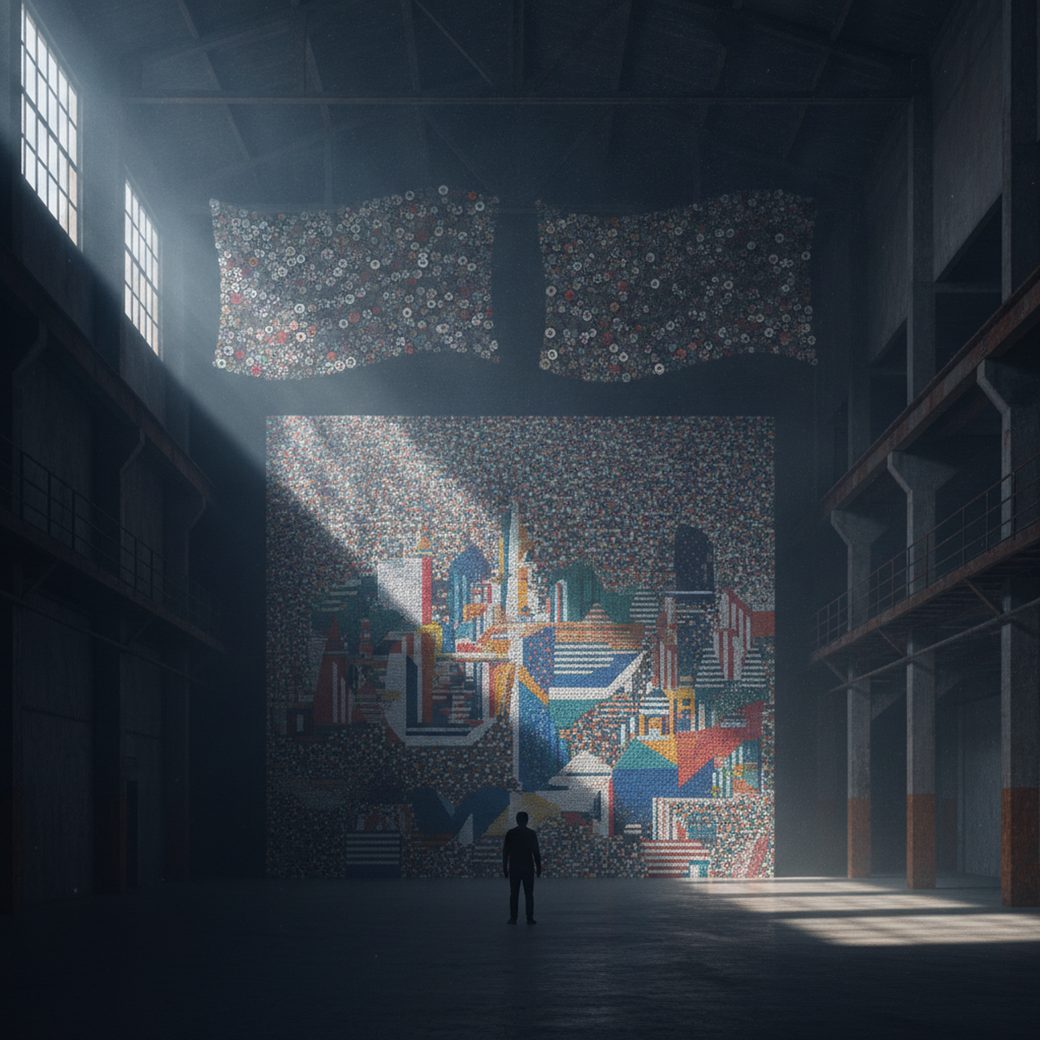
Somewhere in a warehouse in Manchester there are four million buttons, and every single one of them is doing a job. This summer the Chinese artist Ai Weiwei opened Button Up! — his largest site-specific show to date — and it is exactly the kind of thing that makes people mutter "call that art?" while queuing for a ticket anyway. Which is the correct response, because the whole point of the man's career is to make the ordinary object suddenly, awkwardly, refuse to be ordinary.
You do not need an art-history degree to enjoy this one. You need to be a person who has, at some point, lost a button and felt weirdly bereft about it. From there, Ai Weiwei does the rest. Let's walk through the doors.
What is Button Up!, in plain English
From 2 July to 6 September 2026, Factory International has handed Ai Weiwei The Warehouse — the vast, raw industrial hall inside Manchester's Aviva Studios — and let him fill it. According to Factory International, it is the biggest site-specific exhibition he has ever made, pulling together sculpture, painting, ceramics, film and live performance under one enormous roof. The loose theme is heavy: the long shadow of British imperialism, the tangled history of Chinese and British relations, and the rise of globalisation. The materials are, deliberately, as light as a button.
That gap — huge subject, tiny object — is the engine of the whole show. Ai Weiwei has spent thirty years proving that the smaller and more everyday the thing, the harder it hits when you make a mountain of it. He did it with sunflower seeds (a hundred million hand-painted porcelain ones at Tate Modern in 2010). Here he does it with buttons and toy bricks.
The flags made of half a million buttons each
The centrepiece is a work called Eight-Nation Alliance Flags: eight national flags, each one mosaicked from close to half a million buttons. That is roughly four million buttons in total, and there is a genuinely lovely backstory to where they came from. In 2019, when a family firm called A Brown & Co Buttons in Croydon shut its doors after generations in the trade, Ai Weiwei bought its entire remaining stock — 30 tonnes of buttons — and shipped them off to be sewn, by hand, into flags. As The Art Newspaper reports, the eight flags stand for the Eight-Nation Alliance that invaded China in 1900 — a real, bloody episode of imperial history, rebuilt out of the buttons of a dead British factory.
A button holds a coat together. Four million of them, sewn into the flags of the empires that carved up your country, hold something much less comfortable together.
This is the trick worth noticing. On its own a button is nothing — you could not care less about it. Gather four million and arrange them into the flags of invading powers, and the sheer, dumb quantity starts to feel like people: a crowd, a census, a body count. The material stays humble; the meaning does not. It is the same sleight of hand that lets a pile of anything become a monument, if only there is enough of it and it is pointed in the right direction.
A 25-metre wall of toy bricks (and weapons)
If the buttons are the heart, the showstopper is a mural called History of Bombs. Picture a wall 25 metres wide and 10 metres high — bigger than a tennis court stood on its end — covered edge to edge in life-size images of weapons, from ordinary shells right up to weapons of mass destruction. Now picture that it is built entirely from 3.5 million toy bricks, the little plastic kind you stepped on barefoot as a child. Factory International bills it as Ai Weiwei's largest toy-brick artwork ever, and the museum press has understandably led with the number.
The joke and the horror are the same thing. The most innocent object of childhood — the toy brick, pure play, zero stakes — is used to render the least innocent objects humans have ever built. You walk up close and it is a happy field of primary colours. You step back and it is a catalogue of ways to end the world. Ai Weiwei has done the toy-brick move before, most famously in portraits of political prisoners, and it works for the same reason every time: the medium says "harmless," the picture says the opposite, and your brain has to hold both at once.
The 24-hour performance about sewing a button
Then there is the part that sounds, on paper, like the most boring performance art ever conceived — and is the exact opposite. In a piece called Sewing a Button, Ai Weiwei sat and re-enacted his own 2011 secret detention by Chinese authorities, when he was held for 81 days without charge under constant guard. The re-enactment ran for a punishing 24 hours straight, from 5pm on 3 July to 5pm the next day, per Factory International's listing.
Why sewing? Because when you are locked in a room and watched every second, the smallest permitted action becomes the whole of your freedom. "Even sewing a button can be subversive," Ai Weiwei told The Art Newspaper — and the line is the key to the entire building. The show is called Button Up! partly because buttoning up is what you are told to do: fasten your coat, keep quiet, fall in line. Turning that same tiny act into a 24-hour act of endurance flips the instruction on its head.
So is a pile of buttons really art?
Here is the honest bit, because you deserve the skeptical case too. There is a real charge to answer with work like this: that it is "more idea than object" — that once you have read the wall text and clocked the concept ("buttons = empire," "toy bricks = bombs"), you have got everything the piece has to give, and the actual thing in front of you is just a very large, very expensive illustration of a sentence. It is a fair criticism, and it applies to a lot of concept-driven art. If the one-line idea is the whole meal, why build the four-million-button cathedral around it?
The defence is scale and labour, and you feel it in the room in a way no summary conveys. Reading "four million buttons" is a fact; standing in front of them, knowing each was placed by a human hand, is a physical event. The quantity is the argument. It is the difference between being told a statistic about a war and seeing the names carved into a wall. This is also why the same idea printed on a poster would be nothing, and why the warehouse-sized version stops people cold. As we found with the $6.2 million banana, the art world loves to test where the line between "gesture" and "art" actually sits — and the honest answer is that it moves, constantly, and usually lands wherever the work makes you feel something you can't quite argue your way out of.
It helps, too, that Ai Weiwei is not a man playing games from a position of comfort. He has been beaten by police, jailed, surveilled and exiled for exactly the kind of speech this show is built from. When he turns a button into a symbol of control, he is not reaching for a clever metaphor; he is describing his own life. That biographical weight is what separates this from a merely decorative pile of stuff — and it is the same reason a work's context so often carries as much meaning as its surface, a theme we keep circling in reading modern abstraction without the jargon.
How to actually look at it (without the wall text)
If you go — and if you are anywhere near Manchester before September, you should — try one small experiment. Walk up until a flag or the brick wall fills your whole field of vision, close enough that it dissolves into thousands of individual dots. Then walk slowly backwards and watch the image assemble itself out of the noise. That moment, where a swarm of meaningless small things suddenly snaps into a picture, is the entire show in miniature. It is also, not coincidentally, how a silhouette works: lots of nothing, arranged until a shape appears.
You do not have to decide whether it is Great Art on the way out. Ai Weiwei has spent a lifetime insisting that the label matters far less than the looking. What you will not do is forget the sight of four million buttons pretending to be flags — and the quiet, uncomfortable realisation that the most ordinary object in your house has, in the right hands, quite a lot to say.
Quick questions
What is Button Up!? Ai Weiwei's largest site-specific exhibition to date, presented by Factory International at The Warehouse in Aviva Studios, Manchester, from 2 July to 6 September 2026. It spans sculpture, painting, ceramics, film and live performance, themed on empire, Chinese-British relations and globalisation.
How many buttons and bricks? The Eight-Nation Alliance Flags use roughly 4 million buttons — eight flags of nearly half a million each — from 30 tonnes Ai Weiwei bought from a closing Croydon button factory in 2019. The History of Bombs mural is 25m wide, 10m high and made from about 3.5 million toy bricks.
What was the 24-hour performance? Sewing a Button, in which Ai Weiwei re-enacted his 2011 secret detention over a continuous 24 hours (3–4 July), using the small act of sewing to explore surveillance and endurance.