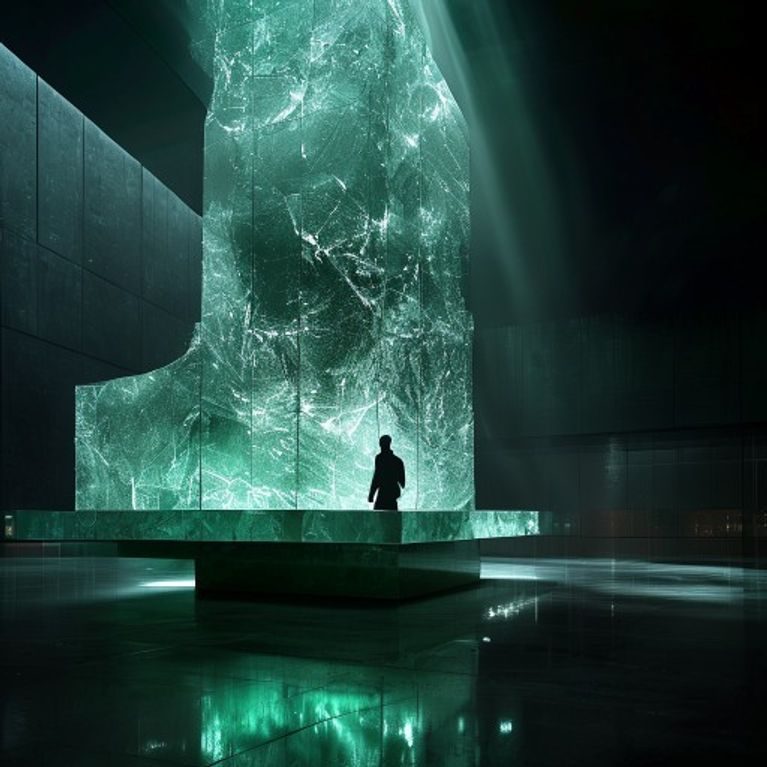
Picture the world's most inconvenient desk. It weighs seven tons. It's made of jagged green glass stacked like a small iceberg mid-collapse. You cannot move it, you cannot fit your knees under most of it, and if you rested a hot coffee on the wrong shard you'd probably feel a little nervous. In July 2026 that desk sold at auction for $243,200 — a record — and the internet did its usual thing, which is to ask, loudly and correctly: it's a desk, how is that art?
The desk is called Icehenge, it was designed by Frank Gehry — the architect behind the Guggenheim Bilbao and the swooping steel Walt Disney Concert Hall — and its journey from a Chicago office lobby to a record-setting auction lot is one of the better "wait, that's art?" stories of the year. So let's do what this site always does: take the eye-roll seriously, then explain why the thing is more interesting than the price tag.
What Icehenge actually is
Gehry made the desk in 2013 as the lobby security station for the Inland Steel Building, a slim 19-storey modernist landmark in Chicago's Loop that Gehry himself had held an ownership stake in. So this wasn't a gallery commission or a rich collector's whim. It was, on paper, office furniture: the desk a security guard would sit behind to check your badge.
Except Gehry built it out of 16 pieces of green-tinted glass, warped and jagged in some places and smooth in others, stacked into columns where the tallest reaches about six feet. The whole thing weighs roughly seven tons — around 15,000 pounds. The nickname "Icehenge" wrote itself: it looks like shattered ice frozen mid-explosion, part Stonehenge, part glacier. According to reporting by Smithsonian magazine, the idea came when Gehry noticed scrap glass during another project and decided to celebrate the material's flaws — its warps and jags — instead of chasing the usual glassmaker's dream of flawless clarity.
Gehry, who is not a man short of good lines, described it best himself. Talking to the Chicago Tribune's architecture critic Blair Kamin back in 2013, he said the desk looked "like an explosion in a glass factory" — adding that a real explosion in a glass factory, "apart from everyone getting killed, would be pretty exciting visually." That single quote tells you everything about why he's Gehry and you or I would just have ordered a desk from a catalogue.
"It does look like an explosion in a glass factory, kind of." — Frank Gehry, to the Chicago Tribune, 2013
The record, in numbers
When Icehenge came up at Freeman's | Hindman in Chicago in July 2026, it carried an estimate topping out around $200,000. It sold for $243,200 — comfortably over — and in doing so set a new auction record for a Frank Gehry design object. The previous high was $239,400, paid for one of Gehry's whimsical "Fish Lamps" at Phillips in New York in 2021. So a security desk just out-earned the lamp.
Two things are quietly funny about that number. First, it's a lot of money for a desk and pocket change for "a Frank Gehry." A Gehry building costs hundreds of millions; a signed one-off object of his that you can put in a room is, by comparison, a bargain trophy. Second, the record is for his design work specifically — furniture, lamps, objects — a whole shadow career that runs alongside the architecture and rarely makes the news. Icehenge just dragged it into the spotlight.
So… is a desk art?
Here's the honest answer, and it's the one the art world doesn't love to say out loud: it depends who made it, why, and who's looking. There's no laser gate at the museum door that pings when a "real" artwork walks through. A desk from a furniture shop is furniture. The same desk, made once by a famous hand, shown as an idea rather than a product, and bought by someone who will never file paperwork on it — that desk has quietly crossed into the zone the market calls design art or functional sculpture.
The tell is usefulness. Icehenge can function as a desk. But its function is basically a costume. Nobody pays a quarter of a million dollars for a seven-ton lobby fixture in order to sit behind it and check badges. They pay for the object, the name, the story, and the slightly absurd fact that a working piece of office furniture is also a sculpture Gehry sweated over. The moment the usefulness becomes optional — a bonus, not the point — you're looking at art wearing a desk's clothes.
Design art has a real lineage, too; this isn't a 2026 gimmick. The Italian Radical Design movement of the 1960s and '70s made deliberately "wrong" furniture to provoke. Gehry himself has been blurring the line for half a century — his 1972 Wiggle Side Chair, made from humble layered cardboard, sits in the collection of the Museum of Modern Art. A chair you could theoretically sit on, in a museum you pay to enter. Icehenge is that same idea scaled up to seven tons and a Chicago skyscraper lobby.
The pattern we keep bumping into
If you've read much of this site, the Icehenge story should feel familiar, because it's the same trick in a new outfit. We keep meeting objects that get called art and set off the exact same argument. A banana taped to a wall sold for millions. A 67-million-year-old dinosaur skeleton went under the hammer for $50 million with people fighting over whether it's science, art, or a billionaire's trophy. Even a small plastic toy monster stormed its way into museum-shop legitimacy.
In every case the object is almost beside the point. What's really being sold is a story and a signature — the framing, the name, the myth around the thing. Icehenge fits the pattern perfectly, with one satisfying twist: the banana was meant as provocative art, while the Gehry desk was meant, at least officially, to be furniture. It backed into being art by being too good, too weird, and too clearly the product of one recognisable imagination to stay in the "office equipment" box.
The banana was built to be art and dared you to disagree. The desk was built to be a desk — and became art anyway. That's the more interesting direction.
The honest caveats
Let's not oversell it. A record price is not proof of greatness — it's proof that on one afternoon, two people wanted the same object badly enough. Auction records are thin evidence: one determined bidder can set a "record" that says more about a single ego than about art history. Design objects are also famously boom-and-bust; a name that's hot this decade can cool fast, and $243,200 today is not a promise about tomorrow.
And there's a fair criticism that "is it art?" is a tired, slightly lazy question — the art world has been comfortable with functional objects as art since Marcel Duchamp signed a urinal in 1917. The genuinely interesting questions about Icehenge aren't whether it counts, but the quieter ones: what's lost when a working public fixture, made for a specific lobby, is pried loose and sold to a private collector? A desk built for a Chicago building becomes a trophy in a room somewhere — a small story about how public design keeps getting privatised, one record lot at a time.
How to look at it (the fun part)
Forget the price for a second and just look. Gehry's whole career is about making rigid, heavy materials — steel, titanium, and here glass — behave like something soft, frozen mid-motion. The Disney Concert Hall looks like billowing metal fabric; Icehenge looks like ice caught a half-second after shattering. The pleasure is the contradiction: your brain knows glass is hard and static, but the shape screams movement and collapse. That tension is the actual artwork, not the desktop.
It's the same skill we talk about in our guide to reading a picture like a critic — you don't need the wall text, you need to notice what the shape is doing to you. And Gehry is a master of letting empty, negative space and jagged edges carry the drama, the exact move we unpack in how emptiness does the emotional work. Stand in front of Icehenge and the gaps between the glass shards do as much as the glass itself.
So is it art or is it a desk? Both, obviously — and that's the whole joke and the whole point. It's a security guard's desk that turned out to be a seven-ton argument about where furniture ends and sculpture begins. Somewhere, a real explosion in a glass factory is jealous of the reviews.
Quick questions
What is Frank Gehry's Icehenge desk? A monumental desk Gehry designed in 2013 as the lobby security station for Chicago's Inland Steel Building, built from 16 pieces of green-tinted glass, weighing about seven tons, with its tallest column around six feet tall.
How much did it sell for? $243,200 at Freeman's | Hindman in Chicago in July 2026 — above its roughly $200,000 high estimate, and a record for a Gehry design object, beating the $239,400 a Fish Lamp fetched at Phillips in 2021.
Is furniture really art? Sometimes. A one-off object by a named artist, collected for its ideas rather than its usefulness, sits in the "design art" grey zone. Icehenge can hold your coffee — but almost nobody buys it to actually work at.