Is Labubu Art? A Fuzzy Monster's Journey from Blind Box to Museum
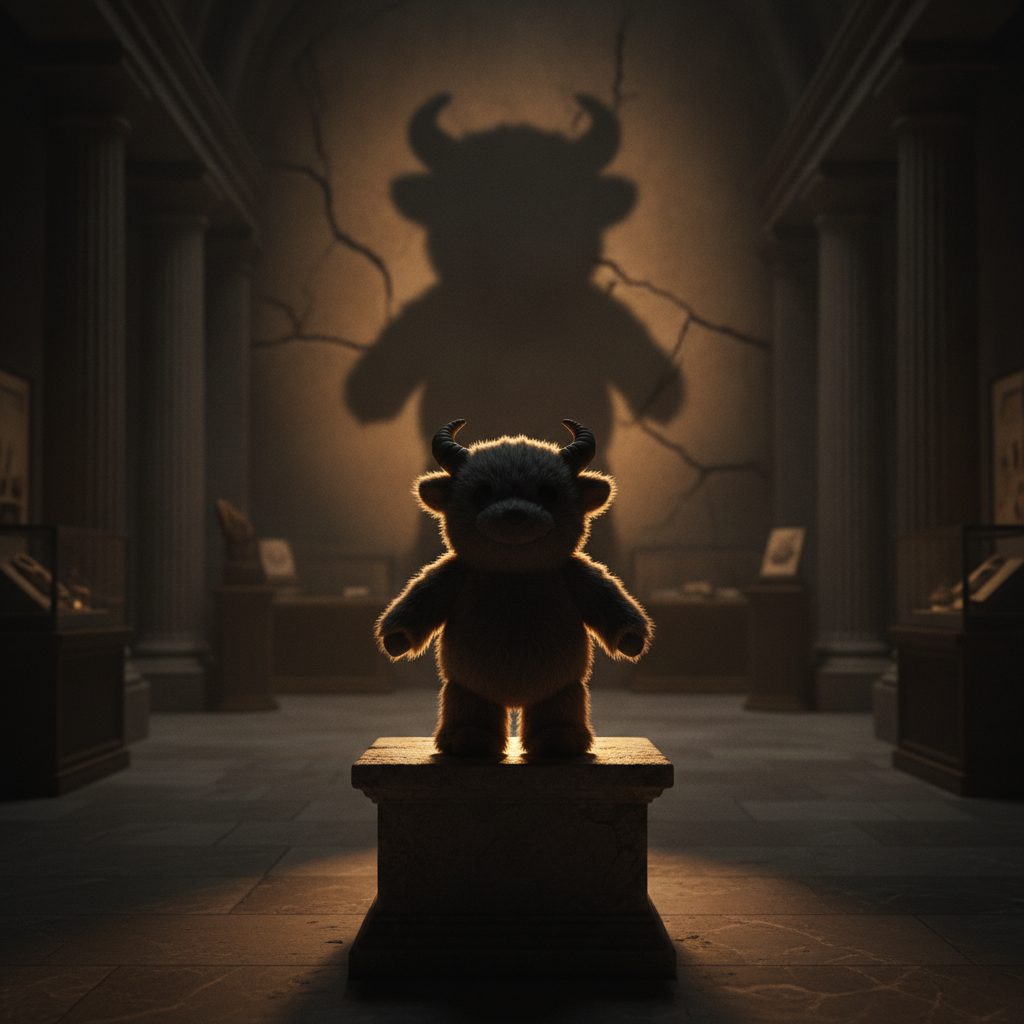
By now you have almost certainly seen one, whether you wanted to or not — a small furry creature with pointed ears, saucer eyes and a row of jagged little teeth, clipped to a designer handbag or peering out of a phone case. That is a Labubu, and over the last two years it has gone from a niche collectible to the single most inescapable object in pop culture. Which raises a question people ask half as a joke and half in earnest: is Labubu art, or just a very good toy having a very good moment?
It is a better question than it sounds, and answering it honestly takes you straight through the middle of what a journal about silhouettes cares about most — recognition, reduction, and the strange machinery that decides what gets to hang on a wall versus what gets sold in a blind box. So let's take the fuzzy monster seriously for a minute.
What even is a Labubu?
Start with the origin, because it matters for the argument. Labubu was not dreamed up by a marketing team. It was drawn by Kasing Lung, a Hong Kong-born illustrator who grew up in the Netherlands steeped in Nordic folklore and fairy tales. In the mid-2010s he built a picture-book world called The Monsters, a tribe of elf-like creatures, and Labubu was one of them — an "ugly-cute" imp somewhere between a woodland sprite and a gremlin who has just done something it shouldn't have.
The now-famous look is deliberate down to the dental work. Lung gave Labubu exactly nine pointed teeth, enough to tip the grin from sweet into faintly menacing — the whole point of the design. That detail has since become so load-bearing that collectors count the teeth to spot fakes: nine and you may have the real thing, ten or seven and you are holding a counterfeit. It is a rare case of an art-authentication test you can run with your naked eye and a bit of patience.
What turned a storybook character into a juggernaut was the toy company Pop Mart, which began selling Labubu figures in "blind boxes" — sealed packages where you don't know which variant you're getting until you open it. Add a slot-machine thrill to a genuinely charming design, sprinkle in a few celebrity fans, and you get the queues, the resale markups and the social feeds full of unboxings that define the Labubu era.
A drawn character, mass-produced by the thousand, that some people now bid on at a fine-art auction house. That single sentence is the whole debate.
The $150,000 monster
If you want the exact moment the "just a toy" defence started to wobble, it was June 2025. At Yongle International Auction in Beijing — a house that normally deals in modern art and jewellery — the first-ever sale dedicated entirely to Labubu went under the hammer. Among the 48 lots was a one-of-a-kind, mint-green, human-sized figure standing 131 centimetres tall. It sold for 1.08 million yuan, roughly $150,000, as reported by Bloomberg.
Six figures for a toy sounds absurd until you remember the art world does this constantly, just with a straighter face. We spent a whole essay on it in the story of the $6.2 million banana — the point being that price is not a measure of artistic merit but of scarcity, hype and the willingness of one rich person to outbid another. A unique 131cm Labubu is scarce in exactly the way a one-off sculpture is scarce, which is why an auction house that usually sells oil paintings was perfectly happy to sell it.
The art market has noticed. Writing in Artnet, critics have compared Kasing Lung's trajectory to that of KAWS — the artist who also started in vinyl toys before his paintings began fetching millions at Sotheby's and Christie's. The toy-to-blue-chip path is rare, but it is not unprecedented, and Lung is now standing on it.
The silhouette is the whole trick
Here is the part that belongs on this particular journal. The reason you can recognise a Labubu from across a crowded train — from the back, in shadow, as a keyring the size of a walnut — is that it has a genuinely great silhouette. Two sharp ears, a round body, that jagged mouth: reduce it to a black shape and it is still, unmistakably, Labubu. That is not an accident of cuteness. It is the same design discipline that makes a Coca-Cola bottle or a red-soled Louboutin readable at a glance.
Great character design and great silhouette art are chasing the same target: maximum recognition from minimum information. A cut-paper portrait works because the human profile carries identity in its outline alone, a trick we traced in the history of the cut shadow. Labubu works because Kasing Lung front-loaded all its personality into the outline and the grin, so no amount of shrinking, blurring or mass production can wash it out. When you can survive being reduced to a shadow and still be yourself, you have done something that most "serious" art aspires to and frequently misses.
So on the narrow question of design, there is no real debate: Labubu is an extremely accomplished piece of visual work. The argument is never really about whether the object is well made. It is about the word we put on it afterwards.
Toy or art? An honest answer
No — and yes, and it depends, which is the unsatisfying and only truthful answer. A Labubu rolling off a production line in the tens of thousands is not "fine art" in the sense a gallery means it; it is a product, designed to be bought, resold and clipped to a bag. Treating every blind box as a masterpiece is the kind of talk that makes actual artists wince, and the skeptics have a real point.
And the skeptics are worth hearing. Plenty of collectors quoted in the coverage warn that Labubu looks a lot like Beanie Babies or Cabbage Patch Kids — viral collectibles whose "investment value" evaporated the moment the hype cooled. Buying a Labubu as a financial asset is a bet on a trend continuing, not on enduring artistic worth, and those are very different wagers. The honest reading is that we simply don't yet know whether Lung's work will still feel significant in twenty years or land in the same bin as the Pet Rock.
But dismissing it as "just a toy" misses something too. It began as an illustrated character with a coherent invented world behind it — closer in origin to a graphic novel than a fidget spinner. Its creator is a real artist with a real body of work. And the same market that decides a duct-taped banana or a signed urinal counts as art has already, repeatedly, decided that toys can cross the line — KAWS, Takashi Murakami, Yoshitomo Nara. The market happily runs the other way too, licensing the old masters as merch — see how LEGO rebuilt Klimt's The Kiss in 4,000 gold bricks. The border between "art" and "not art" is not a law of nature. It is a social decision, renegotiated constantly, and usually in favour of whoever the market is currently excited about. Labubu is simply the latest object standing on the fence while everyone argues about which side it's on. If that idea appeals to you, it is the same territory as reading modern abstraction: the meaning lives less in the object than in how we're invited to look at it.
Seeing it for yourself
You don't need to settle the debate to enjoy the spectacle, and this summer makes it easy. To mark ten years of The Monsters, Pop Mart is taking its anniversary exhibition on a world tour, with a New York stop opening 17 July 2026 in Manhattan's Meatpacking District. Whatever you decide about the art question, seeing the character presented at museum scale — lit, staged, treated as a subject rather than a product — is a small lesson in how presentation itself does half the work of turning a thing into "art."
Try the silhouette test while you're there, or just with the one on your friend's bag. Half-close your eyes until the colour and fluff drop away and only the shape remains. If you can still tell exactly what it is, you're looking at design of a very high order — the same quality that lets a Georgian paper-cut carry a whole person in one black profile. Call it art, call it a toy, call it the most expensive impulse buy of the decade. The outline doesn't care what we name it. It just keeps being instantly, stubbornly recognisable, which was always the hardest trick in the book.
For the fuller backstory, the reference record on Labubu and Kasing Lung's own The Monsters series are the place to start before the next blind box tempts you.
The same question is now being asked one aisle over, about objects with an even humbler origin story: hand-painted animation cels, which studios once threw away and which now sell for tens of thousands of dollars a frame. Mass-market cartoon merchandise keeps quietly re-entering the art market through the collectors' door.
Quick questions
Is Labubu considered real art? There's no settled answer. It's a mass-produced designer toy, which makes many critics resist the "fine art" label — but its creator is a trained illustrator, the character began as a drawn story, and a unique figure sold at a fine-art auction house for over $150,000, so the line is genuinely blurry.
Who created Labubu? Hong Kong-born illustrator Kasing Lung, as part of his picture-book series The Monsters, inspired by the Nordic folklore he loved as a child. Pop Mart's blind boxes then turned it into a global craze.
Why does Labubu have nine teeth? Lung chose nine pointed teeth to make the grin mischievous rather than sweet — the heart of its "ugly-cute" charm. The count is now so iconic that collectors use it to spot counterfeits.