The Thrift Store Painting Worth Millions: What $30 Actually Bought
 By Elena Marchetti · October 19, 2026 · 8 min read
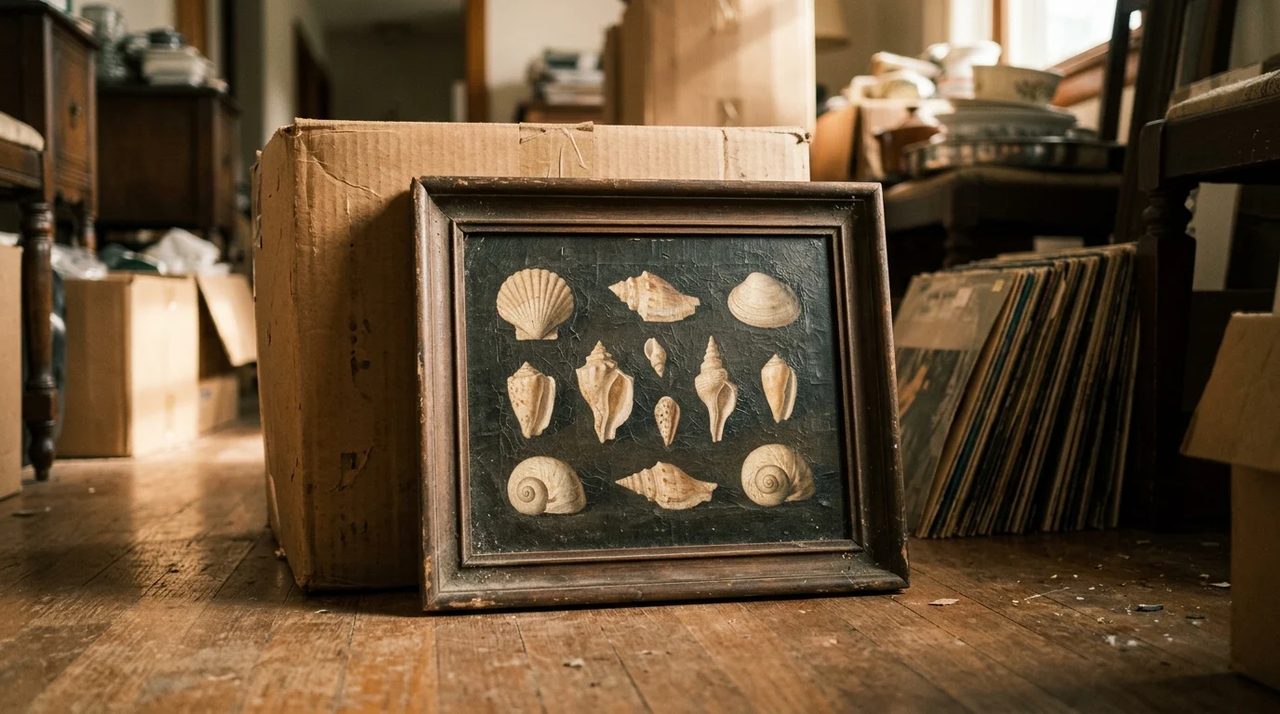
In late July, somewhere in Michigan, a picker walked into an estate sale looking for midcentury furniture and records. In a dim hallway leading to the garage he found a very small painting — ten pale shells on a dark ground, about 8 by 11 inches, in a tired frame. He paid $30.
On 1 October 2026, that painting sold at Freeman's in New York for $1,352,600.
You have read this story before, roughly once a year, and the moral is always the same: keep your eyes open, because fortune hides in junk shops. It's a lovely moral. It is also almost entirely wrong. The $30 was the cheapest and least important part of this story. What turned a hallway curiosity into a seven-figure lot was a specific, unglamorous chain of four conditions — and if you break any single link in it, the same painting is worth a few hundred dollars, or nothing at all, or lands you in federal court.
So let's do the useful version of the viral story.
What was actually hanging in that hallway
The painting is Alderman Merriam's Shells, made in 1951 by Gertrude Abercrombie (1909–1977), the Chicago surrealist known for moons, owls, cats, lone figures and a life spent at the centre of the city's jazz scene. As WBEZ Chicago reported, Abercrombie painted the shells from the collection of Robert Merriam, alderman of Chicago's 5th ward from 1947 to 1955 — the ward containing Hyde Park, where she lived most of her life.
Then she gave it away. In 1952 she traded the picture to Dr John T. Reynolds of Kalamazoo, Michigan, in exchange for medical services. It stayed in the doctor's family and dropped out of public view for roughly 75 years, which is how a documented work by a museum-grade artist ends up leaning in a hallway next to the recycling.
Freeman's estimated it at $150,000 to $250,000. It made more than nine times the low estimate. According to HENI's market report, the result beat Abercrombie's previous auction record by $336,600 — a 33% jump. That previous record, just over $1m for Message for Mercy (1950), had itself only been set at Sotheby's in November 2025.
The painting didn't become valuable in that hallway. It became provable.
The four things that had to be true
Here is the part the headlines skip. A $30 find converts into $1.35m only when all four of these line up.
1. Someone alive could authenticate it. The work was confirmed by Susan Weininger, professor emerita of art history at Roosevelt University and the leading Abercrombie scholar. Attribution is not a vibe; it is a named expert putting their reputation on a specific canvas. For most artists, that person does not exist, is dead, or will not comment.
2. There was a paper trail. This is the detail I find genuinely admirable, and it's the one nobody repeats. The finder didn't just phone an auction house. He redirected a family holiday to visit the touring Abercrombie retrospective at the Milwaukee Art Museum, and there found his painting documented in the exhibition catalogue alongside a 1952 Chicago Tribune review. That is research, not luck. It converted "unsigned small picture that looks a bit Abercrombie-ish" into "catalogued work, publicly reviewed in 1952, missing since."
3. The market had just been repriced. Timing did an enormous amount of the work here. "Gertrude Abercrombie: The Whole World Is a Mystery" — nearly 80 paintings — ran at the Milwaukee Art Museum from 27 March to 19 July 2026 and travels to the Norton Museum of Art in West Palm Beach from 21 November 2026 to 11 April 2027. A major touring retrospective is the single most reliable way an artist's prices get rewritten, as The Art Newspaper has traced across the Magic Realist revival. Find the same painting in 2015 and you are looking at a fraction of this number.
4. The title was clean. Nobody had stolen it. Abercrombie gave it away herself, to a named doctor, for a reason anyone can understand. The chain of ownership runs unbroken from the artist's studio to the estate sale table. Which brings us to the story nobody puts in the feel-good roundups.
The $7 Renoir, and why its finder got nothing
In 2009, a Virginia woman named Marcia Fuqua bought a box of odds and ends at a flea market in Harpers Ferry, West Virginia, for $7. Inside was a small landscape: Paysage Bords de Seine, by Pierre-Auguste Renoir. An actual Renoir, for the price of a sandwich. The perfect sleeper story.
It was also stolen. The painting had been taken from the Baltimore Museum of Art in November 1951. When it surfaced for auction in 2012, the sale was pulled, the FBI got involved, and in January 2014 a federal judge ordered it returned to the museum. The court found the evidence overwhelming: a 1951 police report and the original donor's will. The painting went back to Baltimore. Fuqua kept nothing.
Buying in good faith generally does not launder stolen title. So the same discovery — famous artist, trivial price, hallway odds — produced $1,352,600 in one case and a court order in the other, and the only difference was paperwork. If you want to see how deep that rabbit hole runs, we've written about the 650,000 works looted by the Nazis and the chatbot now searching for them; roughly 100,000 have never come home. Provenance isn't bureaucracy. Provenance is the asset. It is the same reason a headless Roman torso could legally sell for $34.3 million: its paper trail starts in the 1850s. The alternative is a market where a stolen object is just an object, which is precisely the bet made by thieves in France's recent run of brazen museum raids.
The honest odds, with real numbers
Now the part that will cost me some of your optimism.
These stories survive in your memory because of a hard survivorship filter: the millions of $30 paintings that stayed worth $30 do not get written up. The genuine jackpots are spaced out across decades. The record-holder is still a $4 torn painting bought at an Adamstown, Pennsylvania flea market in 1989 by a man who only wanted the frame. Behind the backing, folded, was an original Dunlap broadside of the Declaration of Independence — one of 24 known copies. Sotheby's sold it for $2.42m in 1991; in 2000 it made $8.14m in an online auction to the television producer Norman Lear. That is one document, found 37 years ago.
Meanwhile the ordinary reality of the secondhand art market is brutally unsentimental, and it is getting worse. An entire generation's collections are hitting the resale market simultaneously, and as we covered in the great inherited art dump, the buyers mostly aren't there: brown furniture, decorative prints and competent amateur landscapes are close to unsellable. The overwhelming majority of what you will find at an estate sale is a reproduction, a print, or a sincere painting by someone nobody is researching.
What has changed in the finder's favour is narrower than it sounds. Online price databases and museum catalogues are now searchable from your phone, which is exactly the tool the Michigan picker used. The edge is no longer a good eye. The edge is being willing to spend an evening reading a catalogue raisonné.
What to actually look at, if you want to try
None of this is a guarantee, and anyone who tells you they can teach you to spot a masterpiece in ten minutes is selling a course. But there is a sensible order of operations.
Turn it over first. The back holds the evidence: gallery labels, exhibition stickers, auction lot numbers, stencils, old inventory marks, framer's tags. The front can be imitated; a 1950s gallery label with a half-legible address is much harder to fake and much more informative.
Distrust the signature. It is the single easiest element to forge and the first thing an optimistic seller adds. Weight it near zero until everything else agrees with it.
Check whether it's even a painting. Under a loupe or a phone macro lens, a regular grid of tiny dots means a printed reproduction. Look instead for genuine surface relief, brush ridges catching the light, and age cracking that follows the weave of the canvas rather than sitting on top of it as a printed pattern.
Then do the boring research. Search the title, the subject and any name on the back. Look for a catalogue raisonné and for the scholar who maintains it. Check stolen-art registers before you spend a cent on authentication — that step is what separates the Abercrombie outcome from the Renoir one.
And keep the whole thing in proportion. The art market's prices have never been a measurement of quality; they are a measurement of attention, scarcity and timing. The same machinery that made ten painted shells worth $1.35m is the machinery that put a $50 million dinosaur under auction-house spotlights, revalued cartoon cels the studios threw in the bin, and let a banana taped to a wall clear $6.2m. The object sits still. The story around it does all the moving. If you want a collection that survives that volatility, the saner starting point is our guide to collecting minimalist work on a normal budget.
Gertrude Abercrombie spent her career painting small, strange, moonlit pictures for a Chicago scene that loved her and a wider art world that mostly didn't notice. Seventy-five years after she handed a doctor a picture of shells to settle a bill, the world has decided to pay attention. She is not around for any of it — which is, depressingly, the most traditional part of the entire story.
Quick questions
What was the $30 thrift store painting that sold for millions? Alderman Merriam's Shells (1951) by Gertrude Abercrombie, about 8 by 11 inches, bought for $30 at a Michigan estate sale in late July 2026 and sold at Freeman's in New York on 1 October 2026 for $1,352,600 including fees — a record for the artist, against a $150,000–$250,000 estimate.
How can you tell if an old painting is valuable? Start with the back, not the front: labels, stencils, lot numbers and stretcher construction carry the real evidence. Treat the signature as the least reliable clue. Check under magnification for a grid of printed dots, which means reproduction. Then research the subject and any names you find.
If I find a valuable painting at a thrift store, do I get to keep it? Not necessarily. Good-faith purchase usually doesn't give you title to stolen property. A $7 flea-market Renoir was ordered returned to the Baltimore Museum of Art in 2014 and its finder received nothing. Check stolen-art registers early.
Sources and notes: discovery details, dimensions, the Merriam and Dr Reynolds provenance and the authentication by Susan Weininger of Roosevelt University are from WBEZ Chicago and Chicago Sun-Times reporting of 30 September 2026 and from Freeman's own catalogue entry; the $1,352,600 result, the $150,000–$250,000 estimate and the $336,600 / 33% record increase over Message for Mercy (Sotheby's, 21 November 2025) are from HENI's market report and CNN's coverage of 5 October 2026. Exhibition dates are from the Milwaukee Art Museum and the Norton Museum of Art. The Renoir case rests on the January 2014 federal ruling as reported by CNN and PBS NewsHour. Declaration of Independence figures are the published 1991 Sotheby's and 2000 online auction results. The photograph at the top of this article is an illustration of a house-clearance scene, not a photograph of Alderman Merriam's Shells. Published 19 October 2026.
Elena writes about silhouette art, negative space, shadow play and visual culture for Art Silhouette, where she edits the journal and tests the site's art tools. Her focus is making art theory usable for collectors, designers and beginners.