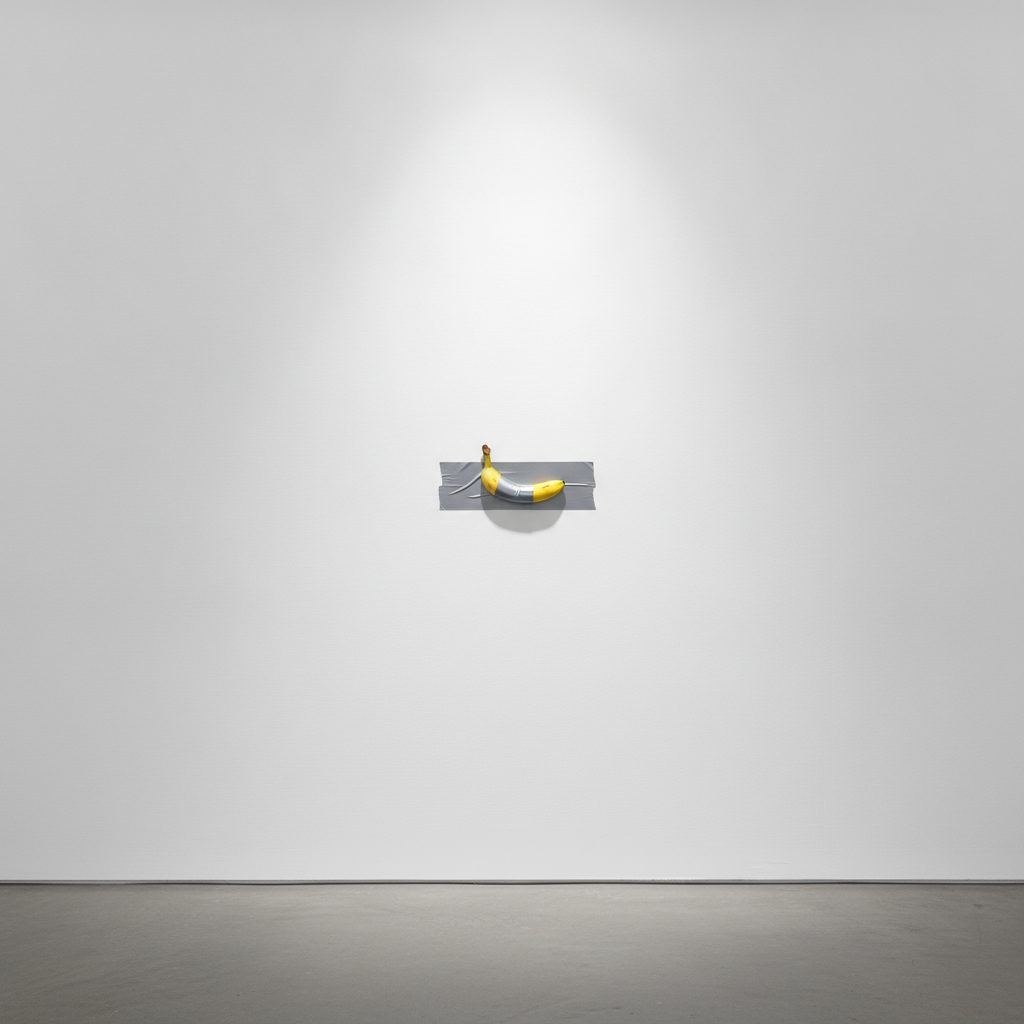
In November 2024, a man paid $6.2 million for a banana taped to a wall. Then he ate it. This is not a parable, not a Monty Python sketch, and not a cry for help. It is simply the art market doing what the art market does — and honestly, it wasn't even the strangest sale of the decade. Grab a coffee (or a piece of fruit, while it's still affordable): here are the most magnificently absurd art transactions in history, every price tag real and verified.
Absurd prices are not new: consider the bronze sculpture that shattered auction records.
The $6.2 million snack
Let's start with the headliner. In 2019, Italian artist Maurizio Cattelan duct-taped an ordinary banana to a wall at Art Basel Miami, called it Comedian, and sold editions for $120,000 apiece. The art world giggled, a performance artist pulled the banana off the wall and ate it on the spot, and everyone assumed the joke had run its course.
It had not. In November 2024, one edition of Comedian came up at Sotheby's New York with an estimate of $1–1.5 million — already bold money for produce. After a seven-minute bidding war, it hammered at $5.2 million, or $6.2 million with fees, to Chinese crypto entrepreneur Justin Sun, who paid in cryptocurrency, which feels thematically perfect.
Sun then flew to Hong Kong, held a press conference at one of the city's most expensive hotels, praised the work as "iconic" — and ate it. Here is the punchline the headlines usually miss: he destroyed nothing. What you actually buy is a certificate of authenticity with instructions for installing a fresh banana at the correct height and angle. The banana is replaced whenever it gets tired. The banana was never the artwork.
The certificate is the artwork. The banana is groceries.
The painting that shredded itself — and 18×'d
October 2018, Sotheby's London. The hammer falls on Banksy's Girl with Balloon at £1.04 million (with fees). Applause. Then an alarm sounds, and the canvas begins feeding itself through a shredder that Banksy had hidden inside the frame years earlier, slicing the lower half into neat ribbons before jamming halfway. (Banksy later admitted it was supposed to shred completely. Even the sabotage malfunctioned.)
Now, you might assume the buyer demanded a refund for her freshly destroyed painting. Instead, she kept it. The work was solemnly renamed Love Is in the Bin, certified by Banksy's own authentication body — the same body that refuses to authenticate murals cut off walls, and in October 2021 it returned to Sotheby's — where it sold for £18.58 million, roughly eighteen times its pre-shredding price and a record for the artist. It remains the only artwork in history that appreciated dramatically by attempting suicide in public. Somewhere, every insurance adjuster on Earth felt a cold shiver and didn't know why.
The sculpture that isn't there
In May 2021, Italian sculptor Salvatore Garau sold a work titled Io Sono ("I Am") at the Milan auction house Art-Rite for €15,000 — comfortably above its €6,000–9,000 estimate. The medium? Nothing. The sculpture is invisible. It is, by the artist's own cheerful admission, made of literally nothing at all.
The buyer received a certificate and instructions to display the piece in an empty space roughly five feet by five feet, free of obstruction, so the nothing has room to breathe. Garau defended the work by invoking the Heisenberg uncertainty principle and the energy of the vacuum, which is the art-world equivalent of a teenager citing quantum physics to explain why their room isn't messy. The best part: an American performance artist threatened legal action, claiming he had made nothing first. There is now prior art for nothing.
The tinned artist (contents: exactly what it says)
Long before bananas and shredders, conceptual art's godfather of trolling was Piero Manzoni. In 1961 he sealed his own excrement into 90 small tins — 30 grams each, labelled Merda d'artista ("Artist's Shit") in four languages, like a fine export product — and priced each tin at its exact weight in gold. It was a joke about the market worshipping anything an artist touches.
The market's response, over the following decades, was to prove him right so hard it hurts: in 2016 a single tin sold at auction in Milan for €275,000 — vastly more than its weight in gold. Manzoni died in 1963 and never saw his prank become a blue-chip asset, which is possibly the darkest punchline in this entire article. And no, nobody knows for certain what's inside; opening the tin would destroy the artwork's value. Schrödinger would have understood perfectly.
The $450 million question mark
And then there is the heavyweight champion. In November 2017, Salvator Mundi — a portrait of Christ attributed to Leonardo da Vinci — sold at Christie's New York for $450.3 million, obliterating every auction record before or since. For scale: that is roughly 72 duct-taped bananas.
The absurdity here isn't the object but everything orbiting it. The painting sold in 1958 for a reported £45 as a copy, was heavily restored, and prominent scholars still argue about how much of it Leonardo actually painted — estimates range from "all of it" to "a hand, maybe." Since the sale it has not been shown publicly anywhere. The most expensive artwork in human history is currently, as far as the public is concerned, playing hide and seek. Undefeated.
So… is it all a scam?
Tempting verdict, but no — it's more interesting than that. Every sale above obeys the same quiet logic: you are never just buying an object. You are buying a story, a certificate, and a moment in art history — the banana is merely the receipt. Cattelan's fruit is a razor-sharp gag about value itself; Banksy's shredder tested whether the market could absorb its own mockery (it could, at 18× markup); Manzoni ran the whole experiment sixty years earlier in tinned form.
There is also a stranger truth hiding in here, one regular readers of this journal will recognise: reduction is power. A single banana on a vast white wall is — whatever else you think of it — a masterclass in negative space, one object made monumental by everything around it that isn't there. The art market didn't pay $6.2 million despite the emptiness. It paid because of it.
If all this has perversely inspired you to start buying art: read our far more sensible beginner's guide to collecting first. It contains the single most important lesson from every story above — the paperwork is the artwork. Also, and we cannot stress this enough: keep your certificate somewhere safe, and your banana in the fruit bowl — the art world already has enough trouble with priceless things walking out the front door.