Nazi-Looted Art Meets AI: The Chatbot Hunting 100,000 Missing Works
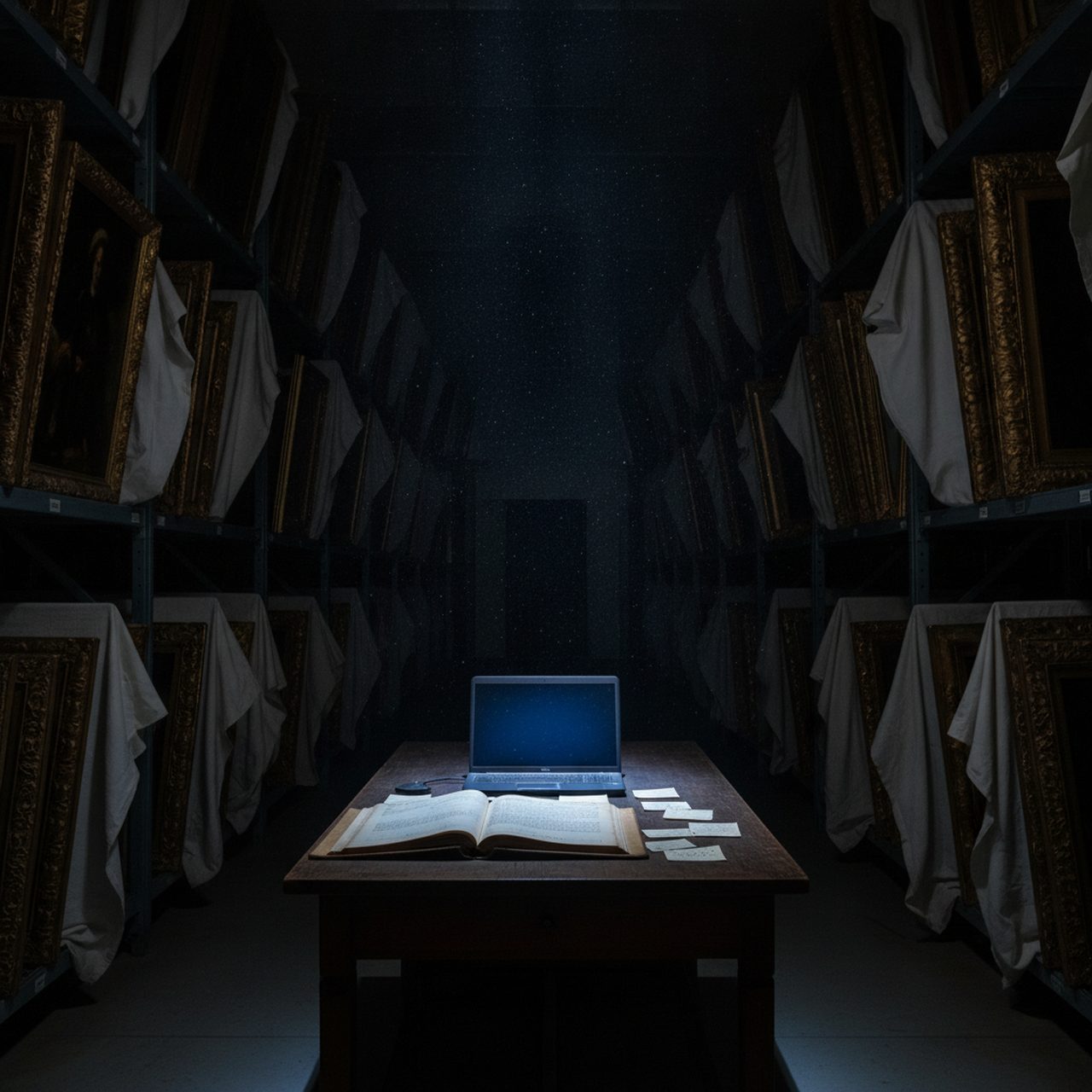
Hollywood sold you a version of this story: Clooney, Damon, a jeep, a salt mine, a Michelangelo hauled out of the dark to a swelling score. The Monuments Men was a lovely film and a genuinely real bit of history — and it ended in 1945, which is roughly where the actual hard part begins.
The hard part looks like this. A woman in Vienna thinks her great-grandfather owned a small Schiele drawing. Somewhere there is a card index, written in German, that might mention it — under a misspelling, or a French translation of the title, or just "Mädchenbildnis," which is the art-historical equivalent of naming a file untitled_final_v2. That's not a heist movie. That's forty years of squinting at microfilm.
Which is why the newest tool in the fight to return Nazi-looted art isn't a commando unit. It's a chatbot.
Three business professors and a very dark spreadsheet
In July 2026, a team at Santa Clara University's business school — management professor Michael Santoro with information-systems professors Haibing Lu and Michele Samorani, plus graduate research assistants — quietly put something called the AI Provenance Assistant online. Their own write-up describes it as a "data docent": you ask a question in ordinary human sentences, and it translates that into a database query and hands back a list of candidate artworks.
The pitch, from Lu, is disarmingly plain: "The AI tool makes it so that anyone can write a question in natural, human language, and it will automatically translate it to the code." The team's stated goal isn't to solve cases outright but to "help researchers identify high-risk works" — the pieces whose paper trail looks wrong enough to deserve a human being's attention.
The story got picked up across the art press over the past fortnight, and it is easy to see why: it's an unusually humble use of AI in a year when most art-world AI headlines are about machines making pictures rather than finding them. Nobody's claiming the bot has taste. It's a librarian with very fast hands.
Why this is so absurdly hard in the first place
Here's the number that reframes everything. Between 1933 and 1945 the Nazi regime seized or forced the sale of an estimated 650,000 artworks — commonly reckoned at around a fifth of all the art in Europe at the time. Estimates of how much has never found its way home vary, but figures around 100,000 works are routinely cited by restitution bodies.
Now the twist that makes provenance research such a peculiar discipline: the Nazis were meticulous record-keepers. The Einsatzstab Reichsleiter Rosenberg — the unit that ran the plunder of Jewish collections in occupied France and Belgium — photographed and catalogued what it took, much of it processed through the Jeu de Paume museum in Paris. Those registration cards survived. Today they sit in a free public database, maintained by the Claims Conference with technical support from the US Holocaust Memorial Museum, containing more than 41,000 catalogued objects.
The thieves left a receipt. It's in the wrong language, in three filing systems, under a name spelled four ways — but they left a receipt.
So the evidence exists. It's just scattered across dozens of archives in German, French, Dutch, Polish, Hebrew and English, built over eighty years by institutions that never agreed on a format. The Central Registry of Information on Looted Cultural Property lists databases by country; Germany runs its own Lost Art register; museums publish their own provenance PDFs. A surname might appear as Grünbaum, Gruenbaum or Grunbaum. A landscape might be filed under its French title in one archive and its German one in another.
This is not a problem AI is bad at. It's close to the ideal case: fuzzy matching across messy multilingual records, where the goal is to shorten a shortlist for an expert rather than render a verdict. Ninety percent of the misery here is spelling.
The Grünbaum case: why a shortlist is worth something
To see what's actually at stake, look at the case that helped spark the project. Fritz Grünbaum was a Viennese cabaret star — a satirist sharp enough that he kept mocking the Nazis from the stage after it stopped being safe. He was arrested in 1938 and murdered at Dachau in 1941. His collection, which included more than eighty works by Egon Schiele, was signed away under duress and dispersed.
His heirs — among them Timothy Reif, a US judge — spent decades chasing those drawings through courtrooms. The results came slowly and then suddenly: in 2023 and 2024, New York prosecutors and civil settlements produced a run of recoveries, with works returned from museums and private collections across the United States, around a dozen Schieles in total. Each one required proving a specific drawing was a specific stolen drawing.
That's the work the bot is trying to compress. Not the justice — the looking. When a family's claim rests on matching a 1938 inventory line to a 2024 auction lot, the gap between a six-month search and a six-minute one isn't a productivity metric. It's whether the claimant is still alive when the answer arrives.
Meanwhile, in Orléans: 424 wanted posters
The chatbot isn't the only creative gambit of the summer, and the other one is gloriously analogue. The Musée des Beaux-Arts d'Orléans has launched a "WANTED" poster campaign for 424 artworks stripped from the museum during the German occupation — including a Chardin — styling each missing painting as an Old West fugitive, yellow saloon-font caps across a black-and-white photograph, pushed out on social media.
It's a beautiful piece of design thinking, and it's doing something the database can't: it makes an absence look like a face. A row of database entries reads as admin. A wall of wanted posters reads as a manhunt. We've written before about how emptiness does the emotional work in art — this is that principle deployed as a search warrant. Both approaches, the AI and the posters, were profiled together by Smithsonian Magazine as evidence that provenance research has entered a scrappier, more public phase.
The honest part: what the machine can't do
Now the caveats, because a tool this sympathetic invites over-claiming, and over-claiming is how good projects get discredited.
It can only find what someone already digitised. The bot is a front end. If a record is sitting in a Polish municipal archive that has never been scanned, no amount of language modelling conjures it. The 41,000 ERR cards are a triumph of digitisation, and they are also one theatre of a continent-wide theft.
A match is a lead, not a proof. Restitution turns on evidence of duress, chains of sale, national statutes of limitation and the good faith of later buyers. The 1998 Washington Conference Principles on Nazi-Confiscated Art, endorsed by 44 states, are non-binding guidance — not law. Countries implement them very differently, and plenty of claims fail on procedure rather than facts.
Chatbots invent things. Any system built on a language model can produce a fluent, confident, wrong answer — and in a field where a fabricated inventory reference could poison a legal claim, that risk is not academic. The project's own framing (identify high-risk works, hand to a human) is the correct posture. Treat any output as a lead to verify against the underlying archive, never as a citation.
It is a volunteer operation. By the team's own account, the effort is unfunded, with plans for a foundation to raise money and hire lawyers if it scales. The tool currently runs on modest research infrastructure. The single most likely failure mode here isn't the AI being wrong — it's the server quietly going away in 2028 when someone's grant cycle ends.
How to check if a painting was looted
If you inherited something, or you're just curious about a piece in your local museum, the amateur version of this work is genuinely doable and free:
- Read the gap. Provenance is a list of owners with dates. Look at 1933–1945. A clean line straight through the war is either excellent record-keeping or a story someone declined to tell.
- Distrust the vague. "Private collection, Switzerland" and "acquired from a dealer, Munich, 1939" are the phrases provenance researchers circle first.
- Search the free registries. errproject.org for the Jeu de Paume cards, lootedart.com for the country-by-country index, and Germany's Lost Art register. Search surnames with every spelling variant you can think of.
- Then stop and call a professional. Seriously. Contact the museum's provenance researcher or a restitution organisation. Confident amateurs publicly accusing collections of holding stolen goods is how legitimate claims get buried under noise.
The pattern this journal keeps meeting
We spend a lot of time here on the gap between what an object costs and what it means — a banana worth $6.2 million because of its story, a 2,500-year-old torque that thieves might melt into a lump worth a used car. Looted art is the most serious version of that same gap. A restituted Schiele has a market price, and the price is not the point. The point is that a specific family was robbed of a specific thing, and the paperwork of the robbery still exists.
There's something fitting about the fix arriving as a database query rather than a rescue mission. The Mona Lisa's 1911 theft made her the most famous painting on earth — theft as accidental fame machine. This is the opposite kind of story: hundreds of thousands of works whose theft made them invisible, catalogued by their thieves and then forgotten in the filing. The chatbot won't right that. But it might make the index cards searchable enough that a few more of them find their way back before the last people who remember them are gone.
Not a swelling score. Just a query returning results. Given the alternative, that'll do.
Quick questions
What is the AI Provenance Assistant? A research chatbot from three Santa Clara University business-school professors — Michael Santoro, Haibing Lu and Michele Samorani — that lets anyone ask plain-language questions about Nazi-seized art and searches provenance records, including the ERR registration cards from occupied Paris. It's a search aid for researchers, not a ruling on ownership.
How much art did the Nazis steal, and how much is still missing? Roughly 650,000 works were stolen or sold under duress between 1933 and 1945 — about a fifth of the art in Europe. Figures around 100,000 unreturned works are commonly cited. Both are estimates from incomplete wartime paperwork, not exact counts.
How can I check whether a painting was looted? Search the free databases — lootedart.com, errproject.org, Germany's Lost Art register — for gaps in ownership between 1933 and 1945 and vague entries like "private collection, Switzerland." A gap is a red flag, not proof; confirming one needs an archivist and usually a lawyer.
How we sourced this
Details of the AI Provenance Assistant come from Santa Clara University's own account of the project and reporting in Artnet News, ArtNews and Smithsonian Magazine published in late July 2026. Database figures are taken from the ERR Jeu de Paume project maintained by the Claims Conference. The Washington Principles text is linked directly from the US State Department. Where a number is an estimate — and most figures in this field are — we've said so. Published 4 August 2026.