There is a specific facial expression people make when they finally reach the front of the Mona Lisa queue. It is not awe. It is the expression of someone who has just been served a starter they thought was a main course. Someone analysed 18,176 online museum reviews and put a number on that expression: 37.1% of everything written about the Mona Lisa is negative, against an average of 19.2% across the 41 famous paintings in the study. Leonardo's portrait finished dead last. Liberty Leading the People — which hangs in the same building, three minutes' walk away — came second at 34.5%, which tells you the problem might be less about Leonardo and more about the postcode.
That study, published by the CouponBirds research team, is not peer-reviewed science — it is keyword sentiment scraping, and it counts words like "crowds" and "disappointing" without asking what they attach to. Take the decimal point with salt. But it lands on something anyone who has been there knows in their knees, and the Louvre's own leadership has said the quiet part out loud. So it is worth asking the honest question: is the most famous painting on Earth actually a letdown, or have we simply built the worst possible machine for looking at it?
It is the size of a bathroom mirror
Start with the physical facts, because roughly half the disappointment is dimensional. The Mona Lisa is 77 by 53 centimetres — about 30 by 21 inches. Hold up a large laptop, add a bit of margin, and you have it. Painted on a single poplar panel some time after 1503, it is smaller than the framed print above most people's sofas.
This matters more than it sounds. We meet the painting as a billboard, a phone case, a coffee mug, a meme. Every version we have ever seen has been bigger than the original. Then you walk into the Salle des États and the thing at the end of the room is the size of a bathroom mirror, behind bulletproof glass, in a climate-controlled box held at 18–21°C and 50% humidity, four metres behind a barrier. Physics does the rest.
Every reproduction you have ever seen is larger than the original. You have been trained your whole life to expect a poster and are handed a postcard.
If you want to feel how brutal that scale mismatch is before you fly to Paris, our wall art size calculator will show you a 77 × 53 cm rectangle against a normal wall. It is a genuinely sobering little exercise, and it is the same reason people are shocked by how small Van Gogh's Starry Night is, or how enormous Guernica turns out to be.
You get about 30 seconds, and 200 phones get them too
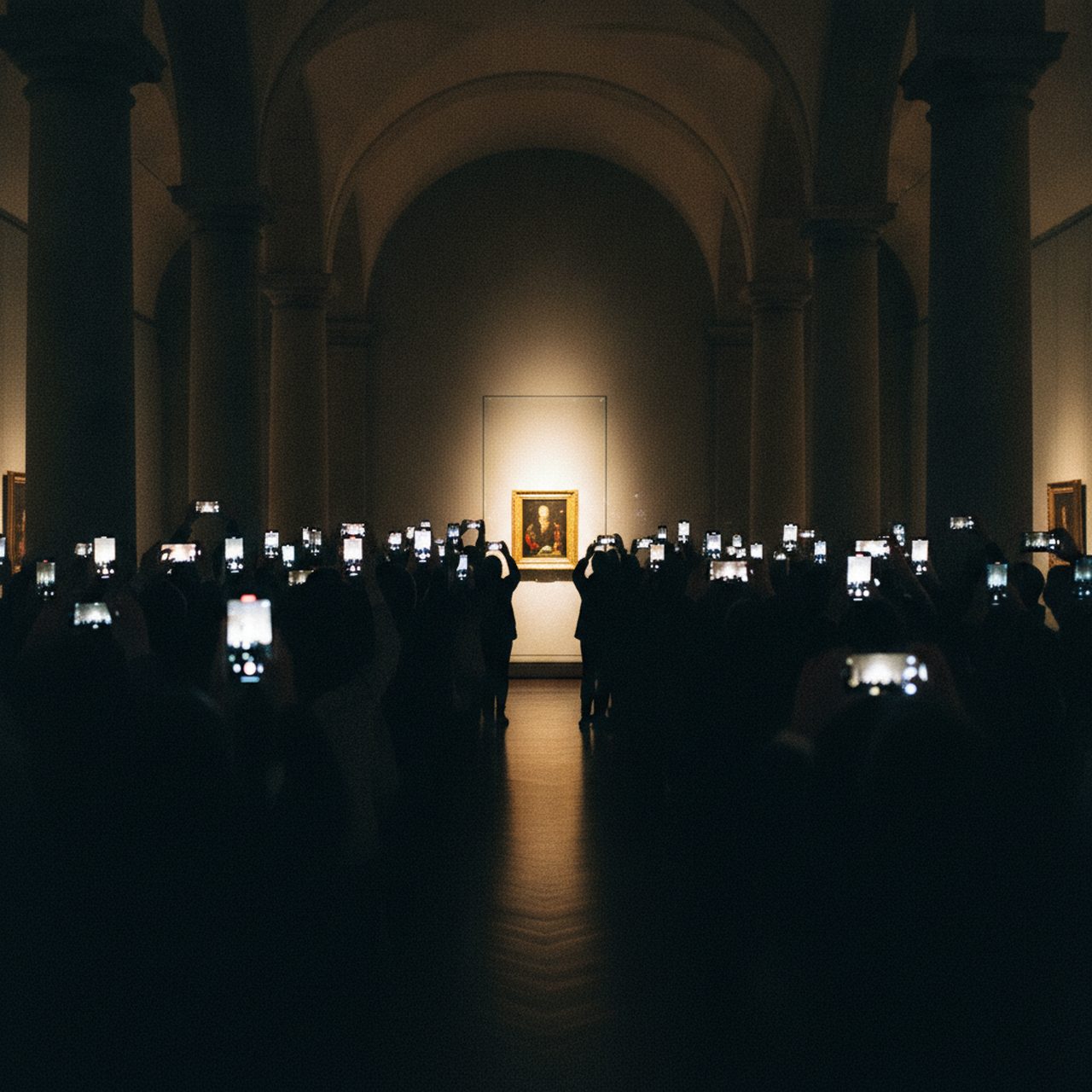
The second half of the disappointment is logistics. The Salle des États takes something in the order of 20,000 visitors a day for one painting. After queuing, the average visitor gets roughly 30 seconds at the barrier before the flow pushes them on. Thirty seconds is not a viewing. It is a drive-by.
And it is not thirty seconds of looking at a painting. It is thirty seconds of looking at the backs of other people's phones, held overhead in a rectangular thicket, each screen showing a small bright version of the thing everyone is failing to see directly. The picture at the top of this article is what the room actually looks like from ten metres back: a field of glowing screens with a distant amber rectangle behind it. The dominant visual experience of the world's most famous painting is a negative-space problem — the artwork has become the small bright gap between silhouetted heads.
We have written before about what happens when the photograph becomes the point of the visit, in selfie museums versus real museums. The joke of the Salle des États is that it has become an accidental selfie museum inside a real one, without any of the good lighting.
The Louvre knows. In a leaked internal memo that became public in January 2025, director Laurence des Cars warned of insulation failures threatening the conservation of artworks and "a lack of space to accommodate visitors, particularly around the Mona Lisa." The pyramid entrance was designed in 1989 for four million visitors a year. In 2024 the museum took 8.7 million. The building is running at more than double its design load, and the pressure point has a name and a smile.
She wasn't always famous. A handyman did that.
Here is the part that reframes everything, and it has an anniversary this month. On 21 August 1911, an Italian handyman named Vincenzo Peruggia — who had worked at the Louvre and helped build the painting's protective glass case — hid in the building overnight, walked out with the panel under his coat and went home. Nobody noticed for over a day. The painter Louis Béroud turned up to sketch in the Salon Carré, found four bare hooks, and asked where the picture had gone.
The Louvre shut for a week. Police interrogated Guillaume Apollinaire and, briefly, Pablo Picasso. The painting stayed missing for two years and four months, recovered on 4 January 1914 after Peruggia tried to sell it to a dealer in Florence, claiming patriotic motives. Meanwhile, Parisians queued to look at the empty wall.
Before 1911 the Mona Lisa was admired by specialists and largely unknown to the general public. The theft made it front-page news on every continent, and it never came back down. As the reference record puts it, the theft and return "led to a massive increase in public recognition of the painting." The most famous artwork in human history was made famous, in large part, by a burglary — a fact that sits neatly alongside the museum heists still happening in France today, though modern thieves tend to take the gold rather than the fame.
So the disappointment has a cruel logic. People are not queuing for a 16th-century portrait. They are queuing for a celebrity, and celebrity is a promise no 77-centimetre panel can keep. It is the same mechanism that made a duct-taped banana worth $6.2 million: the object stops being the thing and starts being the story about the thing.
The €800 million answer: a room of her own
The Louvre's fix is not subtle. On 28 January 2025, President Macron announced the "Louvre New Renaissance" plan, and the headline measure is that the Mona Lisa moves out. She gets a purpose-built room beneath the Cour Carrée, roughly three times the size of her current display space, with a separate entrance and a separate ticket. A new Seine-side entrance is meant to lift capacity toward 12 million visitors a year. The programme is costed at roughly €700–800 million and targeted for 2031, with detail on the dedicated gallery covered by Smithsonian magazine.
Part of the bill is already being collected from visitors. From 14 January 2026, non-EEA ticket holders pay €32 instead of €22 — a 45% increase expected to raise around €17.5 million a year, as reported by Artforum. Americans, who make up over 10% of visitors, and Chinese visitors at around 6%, carry most of it. Norwegians, Icelanders and Liechtensteiners are exempt, which is a sentence that will never stop being funny.
Will a paywall actually fix it?
Honestly: partly, and not for a while. Splitting the Mona Lisa onto her own ticket should genuinely help the rest of the Louvre — the Vermeers, the Géricaults and the Egyptian wing that currently function as scenery on the sprint to Room 711. Decoupling the pilgrimage from the museum is smart.
But the underlying maths is unchanged. Twenty thousand people a day still want to stand in front of one small panel. A bigger room lengthens the viewing window; it does not create hours. And a separate ticket adds a new failure mode — pay extra, get four minutes instead of thirty seconds, and the disappointment may simply arrive with a receipt attached. Nothing changes before 2031 regardless, so every visit between now and then is the current experience at the new price.
How to actually enjoy the Louvre this year
Three things that work, none of them clever:
Go to her last, not first. Almost everyone enters and turns toward the Denon wing. Spend two hours anywhere else while the queue peaks, then arrive late. The room genuinely empties in the final hour.
Look at the room, not just the painting. The Salle des États also holds Veronese's The Wedding Feast at Cana — at nearly 10 by 7 metres, the largest painting in the Louvre, hanging directly opposite the Mona Lisa and reliably ignored by a thousand people at a time who have their backs to it. It is the single funniest sightline in European art.
Decide what you are there for. If you want the photograph, take it in ten seconds and stop resenting the crowd — that is a legitimate reason to go and you have achieved it. If you want to look at a Leonardo properly, go and stand in front of The Virgin of the Rocks or Saint John the Baptist, both in the same museum, both with nobody in front of them. You can have five minutes alone with a Leonardo in the Louvre today, for free, as long as it is not that one.
The last thought is the one this journal keeps returning to. Reduce the Mona Lisa to its outline — the tilted torso, the folded hands, the head turned three-quarters — and you get a shape so over-reproduced it is basically a logo, readable in one glance from across a room, exactly like the cut-paper profiles that made silhouettes a mass medium. That total recognisability is why it is famous. It is also, precisely, why standing in front of it feels flat: there is nothing left to discover, because you already knew the shape before you were old enough to read. The disappointment is not the painting's failure. It is the price of winning.
Quick questions
Why is the Mona Lisa so disappointing in person? Rarely the painting's fault. It is 77 × 53 cm, behind bulletproof glass, at the far end of a room absorbing around 20,000 visitors a day, and you get roughly 30 seconds through a wall of raised phones. The CouponBirds review analysis put 37.1% of its mentions in the negative column, worst of the 41 artworks studied.
Will the Mona Lisa get her own room? Yes — a purpose-built gallery under the Cour Carrée with a separate entrance and separate ticket, part of the €700–800m "Louvre New Renaissance" announced in January 2025 and targeted for 2031. Nothing changes for visitors before then.
How big is the Mona Lisa? 77 by 53 centimetres, about 30 by 21 inches — roughly a small bathroom mirror. It is painted on one poplar panel, which is why it never travels.