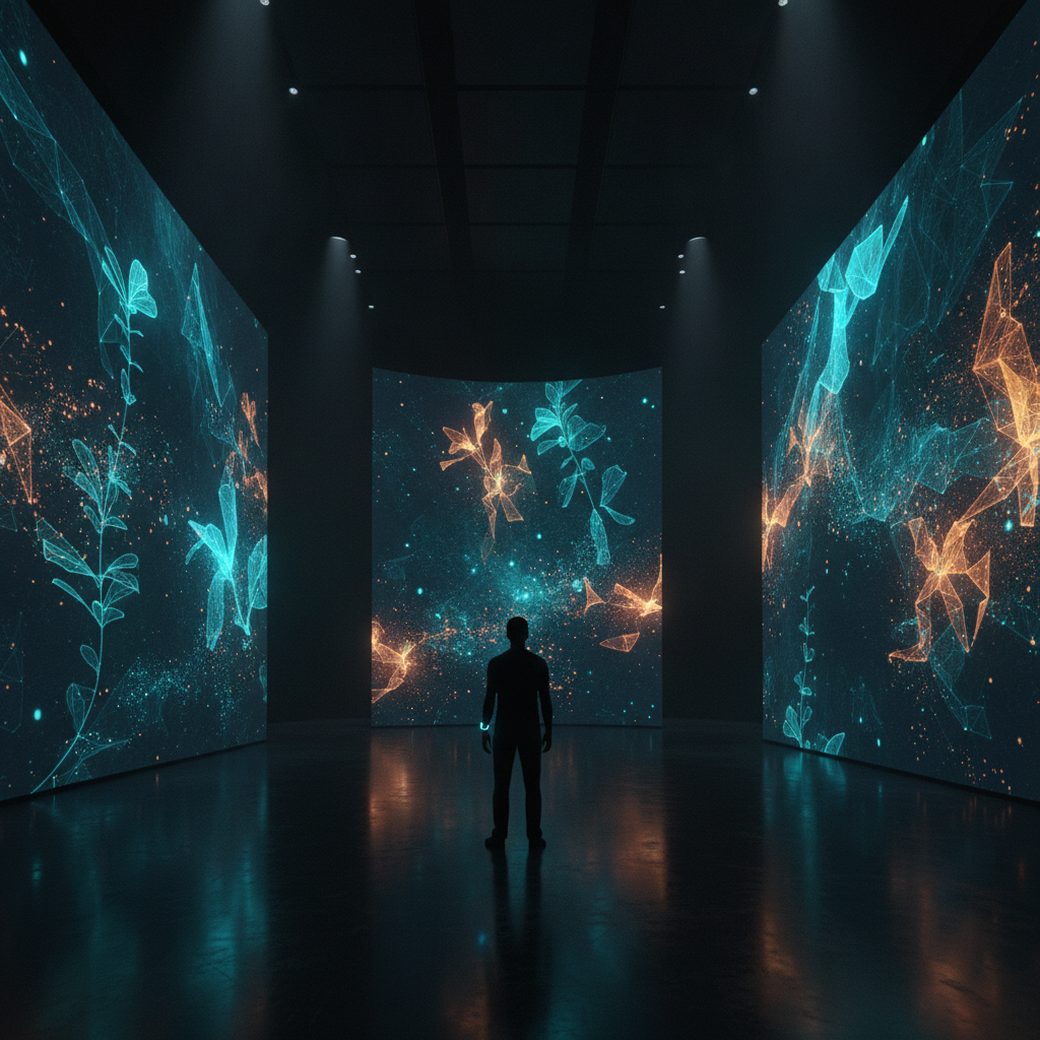
For about a century, the joke about modern art has been "my kid could do that." As of this summer there is a new punchline, and it is "my laptop could do that." In June 2026 the world's first AI art museum opened its doors in downtown Los Angeles — five galleries devoted entirely to art made by, with and about artificial intelligence. It is called Dataland, and depending on who you ask it is either the future of the medium or the most expensive screensaver ever built. Both camps are worth taking seriously, so let's walk through the doors and look.
This is, on the face of it, a long way from cut-paper shadows. But it turns out to be the same argument the art world has been having for two hundred years, just with better lighting — a question about where the human ends and the tool begins, and who gets to call the result "art."
What Dataland actually is
Dataland opened on 20 June 2026 inside Frank Gehry's stainless-steel building, The Grand LA, directly across from the Walt Disney Concert Hall. It was co-founded by the Turkish-American digital artist Refik Anadol and his partner Efsun Erkılıç, and it bills itself, per the engineers who built it, as "the world's first Museum of AI Arts." Five galleries fill roughly 25,000 square feet. There are no canvases on the walls. The walls are the canvases.
The opening show, Machine Dreams: Rainforest, runs until the end of January 2027, and it is the clearest statement of what Anadol is up to. Rather than pull images off the open internet — the practice that has landed so many AI tools in copyright court — he trained a custom system he calls the Large Nature Model on more than 500 million nature images spanning some 2.2 million species. Live weather data from sixteen real rainforests streams into the galleries in real time, so the imagery you see is, loosely, what the rainforest is "feeling" at that moment. In three of the rooms it goes a step further: visitors wear a bracelet, and the picture on the wall bends in response to your own heart rate and movement. The room watches you back.
There are no paintings at Dataland. There is a machine that has looked at half a billion pictures of nature, and a room that changes shape when your pulse does.
The $15,000 robot and the 34-minute sell-out
If the galleries are the art, the gift shop is where the argument gets sharp — and very expensive. General admission is a fairly normal $49 to $79. But Dataland has quietly turned the museum-as-experience model into a luxury boutique. You can walk out with a personalised AI-generated T-shirt for about $15. Or you can commission a painting from Qualia, a robotic arm that produces a single one-of-a-kind canvas each day, generated from a visitor's biometric data, for $15,000 — and there is already a waiting list.
The clearest signal of demand came before the doors even opened. A run of 1,000 limited "data sculptures," priced at $5,000 each, sold out in 34 minutes, according to reporting in IEEE Spectrum. Five million dollars, gone in the time it takes to watch a sitcom. Whatever you think of the art, the market has cast its vote with startling speed.
This is the part that should feel familiar. We have watched money and hype decide what counts as valuable before — most memorably in the story of the $6.2 million banana, where a piece of fruit and a strip of duct tape outsold work that took years to make. Price has never been a measure of artistic merit. It is a measure of scarcity and desire, and a robot that makes exactly one painting a day is engineered scarcity of the purest kind.
"A massive techno lava lamp"
Now the skeptics, because they are not cranks and they have a real point. Anadol's work has drawn eye-rolls from serious critics for years. When his data installation Unsupervised filled a wall at New York's Museum of Modern Art in 2022, a New York Magazine critic memorably dismissed it as "a massive techno lava lamp" — beautiful, hypnotic, and about as intellectually nourishing as a screensaver. The charge is that this is spectacle engineered to photograph well for Instagram, not art that asks anything of you.
The deeper objection is about authorship. Christiane Paul, the veteran digital-art curator at the Whitney Museum, has drawn a firm line: "a visual created by a prompt is not art." Her point is not that computers can't make art — she has spent a career arguing they can — but that there is a world of difference between an artist who builds and trains a bespoke system over years and a tourist typing "rainforest but epic" into a public generator. One is a practice. The other is a vending machine. Collapsing the two, the argument goes, is exactly how you get a gallery full of pretty nothing.
It is worth sitting with that discomfort rather than waving it away. A lot of what passes for "AI art" online really is empty — technically dazzling, emotionally inert, and interchangeable. If you have scrolled past a hundred hyper-real AI landscapes and felt precisely nothing, your instinct is not wrong. Volume is not depth, and a machine that can make anything often ends up making things that mean nothing in particular.
The case for the defence
And yet. Every genuinely new medium has been met with the same sentence — "that's not real art" — and the sentence has been wrong every single time. Photography spent decades being sneered at as mere mechanical copying before anyone would hang it in a museum. The same was said of film, of collage, of screen-printing, of video. The tools that felt like cheating to one generation became the serious media of the next. There is no obvious reason to assume AI is the one exception in that long, embarrassing history of being wrong.
What makes Anadol harder to dismiss than the prompt-typers is that he did the unglamorous work. Building the Large Nature Model on ethically sourced, credited data — rather than scraping other artists' pictures — is a deliberate answer to the medium's biggest ethical problem. That is a choice, made by a person, with intent. If art is the meaningful arrangement of a medium toward feeling, then curating half a billion images of nature into something that breathes with the real weather of real rainforests is at least a candidate for the title, whatever we ultimately decide to call it. As with any reductive or abstract work, the meaning lives less in the pixels than in how you're invited to look — the same shift in attention we traced in reading modern abstraction without the jargon.
There is also the small matter that this is not the first object to be dragged into the "is it art" courtroom, and the court keeps ruling in surprising ways. A fuzzy blind-box toy did it last month; we asked exactly this question in whether Labubu counts as art, and the honest answer there — no, and yes, and it depends — turns out to fit a data-rainforest just as well. The border between art and not-art is not a law of physics. It is a social decision, renegotiated constantly, usually in favour of whoever the culture is currently excited about. Right now, that is a robot in Los Angeles.
Worth noting, too, that generating pictures is the loud half of what AI is doing to the art world. The quiet half is archival: a chatbot built by three business professors is now searching 41,000 records of art the Nazis stole, matching misspelled surnames across eighty years of incompatible databases. Less spectacular than a data rainforest. Considerably more useful.
So — is it art?
Here is the honest verdict, and it is deliberately unsatisfying. Dataland is not proof that AI art is real art, and it is not proof that it isn't. It is proof that the question has moved out of the seminar room and into a 25,000-square-foot building with a queue outside. Some of what hangs — glows — on those walls will look, in twenty years, like the birth of a medium. Some of it will look like the Pet Rock of the 2020s: a beautiful, lucrative fad that everyone quietly agreed to stop mentioning. My honest guess is that both will be true of different rooms in the same museum, and that we won't know which is which for a decade.
What is not in doubt is that the oldest tricks still do the heavy lifting. Stand in that dark gallery and the thing that moves you is not the algorithm; it is the sight of one small human shape dwarfed by a wall of light — the same composition that made a Georgian paper-cut or a lone figure on an empty canvas land two centuries ago. The machine generated the rainforest. The feeling came from putting a person in front of it and letting the silhouette do what silhouettes have always done. Whatever we end up calling this stuff, that part is very old, very human, and not going anywhere.
If you want to judge for yourself, Dataland's own about page lays out the mission, and the skeptical case is put well in both Artforum and Artnet News. Read the boosters and the critics, then buy the $79 ticket and decide with your own eyes — which, gloriously, is still the only art-detector that has ever really worked.
Quick questions
What is Dataland? The world's first museum of AI arts, opened 20 June 2026 in Frank Gehry's The Grand LA in downtown Los Angeles. Co-founded by Refik Anadol and Efsun Erkılıç, it spans five galleries and about 25,000 square feet; the opening show, Machine Dreams: Rainforest, runs to 31 January 2027.
Is AI art real art? There's no settled answer. Curators like the Whitney's Christiane Paul draw a line between a considered practice — training your own model with intent — and simply typing a prompt. Others note that photography, film and video all faced the identical "not real art" charge before being accepted.
How much does it cost? Admission is roughly $49–$79. An AI-generated T-shirt is about $15; a one-of-a-kind painting from the Qualia robot, made from your biometric data, is $15,000 — one produced per day, waiting list included.