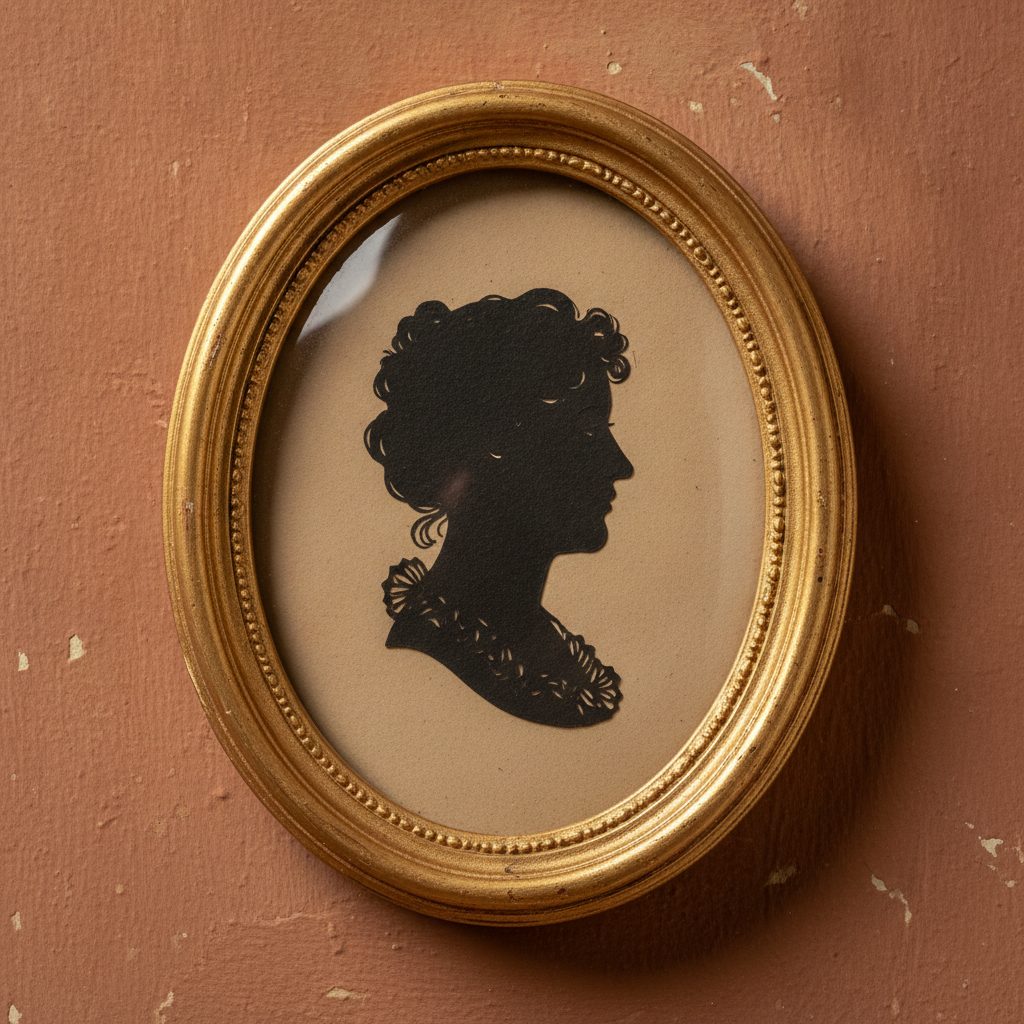
The silhouette is the most democratic portrait ever invented. For roughly a century — from the 1760s to the arrival of photography — it was how ordinary people, not just the wealthy, could own a likeness of the faces they loved. It cost a few pennies, took minutes, and reduced a human being to the one thing a shadow can carry perfectly: the profile.
What makes that history strange is where the name comes from. It was never meant as a compliment.
An insult that stuck
In 1759, France was broke from the Seven Years' War, and Louis XV appointed a controller-general of finances named Étienne de Silhouette. His remedy was austerity: new taxes on the rich, cuts to pensions, an attack on visible luxury. Parisian society loathed him. Within months, anything done cheaply or on the tightrope of economy was mocked as being "à la Silhouette."
Profile portraits cut from black paper — the cheapest possible likeness — were exactly that kind of economy, and the name attached itself to them. Silhouette left office after less than a year, but the word he lent, against his will, has outlived every policy he ever passed.
The cheapest form of portrait in the 18th century now carries the name of the man who tried to make France spend less.
The shadow before the scissors
The idea is far older than the word. Pliny the Elder tells a founding myth of painting itself: a Corinthian woman traces the shadow of her departing lover on a wall so she will still have his outline when he is gone. That gesture — capturing a person by their cast shadow — is the whole silhouette tradition in one image.
By the 1700s it had a method. A sitter was placed side-on between a candle and a sheet of paper; their shadow fell onto the page and an artist traced the edge. The tracing was then filled in solid black, or cut from black paper and mounted on a pale card. Two techniques ran in parallel for a hundred years: painted silhouettes (brushed in ink or lampblack, sometimes on glass or plaster) and cut silhouettes (scissored freehand or from a traced line).
Machines for the middle class
Demand created gadgets. The physiognotrace, refined in the 1780s, was a pantograph-like device: an operator ran a pointer around the sitter's profile while a linked arm engraved or cut a reduced copy. It made likenesses fast, repeatable and cheap enough for a working family. In the United States, Charles Willson Peale installed one in his Philadelphia museum, and thousands of Americans walked out with their profile in minutes.
This is the part collectors often miss: the silhouette boom was really an early experiment in mass-produced portraiture. It answered the same hunger that photography would later satisfy — the wish of ordinary people to be pictured — decades before the camera existed.
The masters of the black profile
Within the cheap medium, real artists emerged. Augustin Edouart, a Frenchman working in Britain and America, cut full-length silhouettes freehand with scissors, no tracing at all, and kept duplicates — some 100,000 of them — that now form a priceless record of ordinary Georgian and early-Victorian faces. He insisted on the word "silhouette" at a time when English speakers still called them "shades" or "profiles," and he helped it win.
The Swiss theologian Johann Kaspar Lavater gave the form an intellectual afterlife — and a problem. His hugely popular books on physiognomy claimed you could read character, even morality, from the outline of a face, and he used silhouettes as evidence. The science was nonsense and, later, actively harmful; but it made the profile an object of serious study and drove the fashion even higher.
Eclipse and afterlife
Photography ended the silhouette's reign almost overnight. Why sit for a traced shadow when a daguerreotype could capture every detail? By the 1860s the parlour silhouettist was a fading trade, surviving mostly as a seaside novelty and a children's amusement.
But the idea never left art. Reduce a subject to a flat, filled shape and something happens: detail drops away and character, gesture and design step forward. That is exactly what modern artists went looking for. Matisse's late cut-outs, the flat black figures on Greek vases reborn in Art Deco, and — most powerfully — Kara Walker's room-sized silhouette tableaux, which turn the medium's genteel history against itself to confront American slavery, all descend from the traced shadow on the parlour wall.
The silhouette survives because it was never really about being cheap. It was about the discovery that an outline, with everything else stripped out, can hold a whole person. That is a modern idea — it just happened to arrive two hundred years early, wearing black paper.