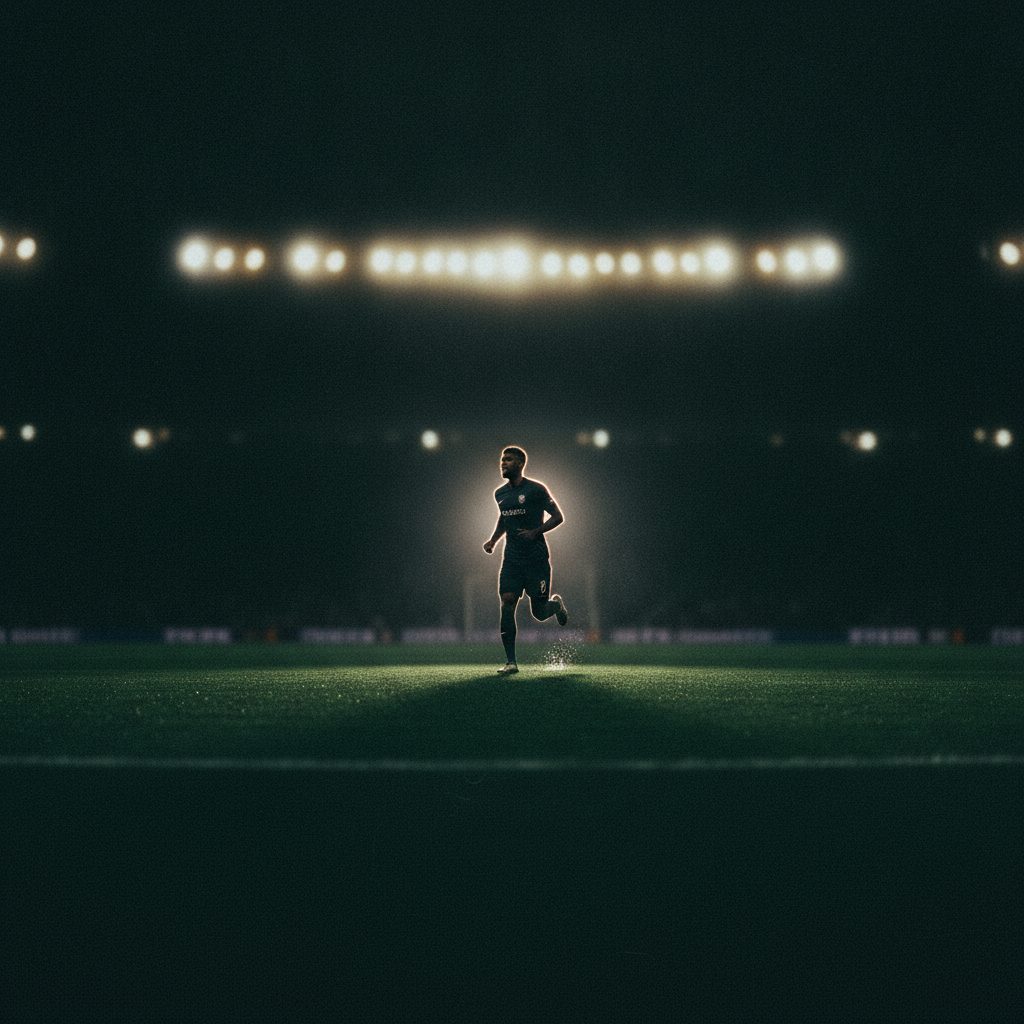
With the 2026 World Cup filling every screen between now and the final on 19 July, here is a strange thing to try: watch a match and ignore the ball completely. Pick one player and follow only them — the walking, the spitting, the standing around, the sudden violence of a sprint. Do that and you have stumbled onto one of the great pieces of contemporary art of this century, and the reason football as art is not the pretentious idea it sounds like.
In 2005, two artists did exactly this, on purpose, with a budget most galleries could only dream of. The result is a film that turns a fairly ordinary league game into a portrait — and it tells you something real about how art works, whether or not you care about football at all.
The day a football match became a portrait
On 23 April 2005, Real Madrid played Villarreal at the Santiago Bernabéu. Nothing about the fixture was historic. What made it extraordinary was that Scottish artist Douglas Gordon and French artist Philippe Parreno had ringed the stadium with seventeen synchronised cameras, every single one pointed not at the game but at one man: Zinédine Zidane. For the full ninety minutes, the cameras refused to look anywhere else.
The film they cut from that footage, Zidane: A 21st Century Portrait, premiered at the Cannes Film Festival in May 2006. And it is genuinely odd to watch. You almost never see the play. You see a face, a pair of boots dragging chalk lines in the grass, sweat, muttering, the small tics of a man alone inside a crowd of eighty thousand. The Scottish band Mogwai supplied a slow, brooding score. For long stretches nothing "happens," and then Zidane explodes into a moment of impossible grace and you understand why anyone bothered.
They pointed everything at one man and let the game blur into background. What's left isn't a match — it's a portrait that happens to be wearing shorts.
Why one figure and not twenty-two
Here is the part that belongs on a journal about silhouettes and negative space. Gordon and Parreno's real move was subtraction. A football broadcast gives you everything: two teams, the ball, replays, graphics, the whole busy field. They threw almost all of it away and kept one figure. Everything else — the other twenty-one players, the ball, the score — became negative space, a blurred ground whose only job is to make the single subject legible.
It is the same instinct that powers a cut-paper silhouette or a spotlight in a dark theatre. Remove enough, and what remains gets all the attention the rest gave up. A portrait painter does this with a plain background; a photographer does it by throwing everything but the eyes out of focus. Gordon and Parreno just did it with a Champions League-grade camera rig and one of the best players alive. The technique is ancient; only the scale was new.
That is also why the film reads as a "21st century portrait" rather than a sports documentary. A documentary wants the story of the game. A portrait wants the person — and to get the person, you have to be willing to lose the game. Watching it, you slowly stop asking "what's the score" and start asking "what is he thinking," which is exactly the question every good portrait since the Renaissance has been built to provoke.
The ending nobody scripted
Then comes the twist that no artist could have planned. Late in that April 2005 match, Zidane was drawn into a scuffle and sent off — the film's "subject" walking to the tunnel in a red card of real drama, as if the portrait had written its own tragic third act. Fourteen months later, in July 2006, the world watched Zidane end his entire career by headbutting Marco Materazzi in the World Cup final and getting sent off again, on the biggest stage football has.
Suddenly the quiet art film looked prophetic. A work about a man's inner weather had, by accident, caught the exact fault line that would define his legend: the sublime and the self-destructive, one heartbeat apart. Art critics could not have asked for a better gift, and they have been dining out on it ever since. It is a useful reminder that some of the most powerful things in art are the ones the artist didn't control — the crack in the plan where reality leaks in.
Is football actually art? An honest answer
No — and yes, and it depends, which is the least satisfying answer and the only truthful one. A football match is not made as art. Nobody plays a cup tie hoping to be hung in a gallery, and treating every skilful goal as "poetry" is the kind of talk that makes both artists and footballers cringe. The game's purpose is to win, and that plain fact keeps it honest.
But artists have treated athletes as serious subjects for as long as there have been athletes — from the muscled bronzes of ancient Greece to the boxers of George Bellows. What Gordon and Parreno proved is narrower and more interesting: you can take the raw material of sport and, with the tools of fine art — framing, focus, sound, duration — turn it into something that behaves like a painting. The football isn't the art. The looking is. That distinction is the whole game, and it is the same one that separates a snapshot from a photograph, or a doodle from a drawing. If you want that argument made without the jargon, it is the same territory as reading modern abstraction: the work is in how you're asked to look, not in what you're looking at.
It is worth being sceptical, too. The film is slow, divisive, and more than a few people find it unwatchable — a fair reaction to ninety minutes of a man jogging. And there is an uncomfortable echo of the wider art market here, where a single famous name can turn the ordinary into the priceless. A urinal, a duct-taped banana, a footballer walking: put the right frame around almost anything and the question stops being "is it good" and becomes "is it art," which are not the same question. We took that circus apart in the story of the $6.2 million banana, and the Zidane portrait sits on the same shelf — half masterpiece, half dare.
Watching the 2026 World Cup like a critic
You don't need seventeen cameras to borrow the idea. The World Cup 2026 runs across sixteen host cities in the United States, Canada and Mexico, ending with a final at MetLife Stadium in New York/New Jersey on 19 July — and the broadcast will, as always, show you everything at once. The artist's trick is to refuse it. Next time you watch, pick one player and hold your eye on them through a passage of play when they're nowhere near the ball. Watch how they move in the dead time, how they carry frustration, where they look.
Do it for two minutes and the match reorganises itself around a single human being. The crowd, the noise, the other players all recede into ground; one figure comes forward as subject. That is the entire lesson of the silhouette, of negative space, of portraiture — delivered, for once, at full volume and in real time, with a hundred thousand people accidentally providing the frame. Football didn't set out to be art. But look at it the right way, and it can't help itself.
For the source material itself, the National Galleries of Scotland and the Solomon R. Guggenheim collection both hold and document the Zidane portrait — worth a look before the next kickoff.
Quick questions
Is Zidane: A 21st Century Portrait a real film? Yes — a 2006 work by Douglas Gordon and Philippe Parreno, filmed with 17 cameras on one player during a Real Madrid match on 23 April 2005, and premiered at Cannes.
Can football really be art? A match isn't made as art, but artists have used sport as subject for centuries, and the Zidane film uses the tools of fine art — framing, focus, sound — to turn a game into a moving portrait.
Where can I see it? The film is distributed through Gagosian and has shown at major museums worldwide, with a presentation timed to the 2026 World Cup; public collections like the National Galleries of Scotland also document it.