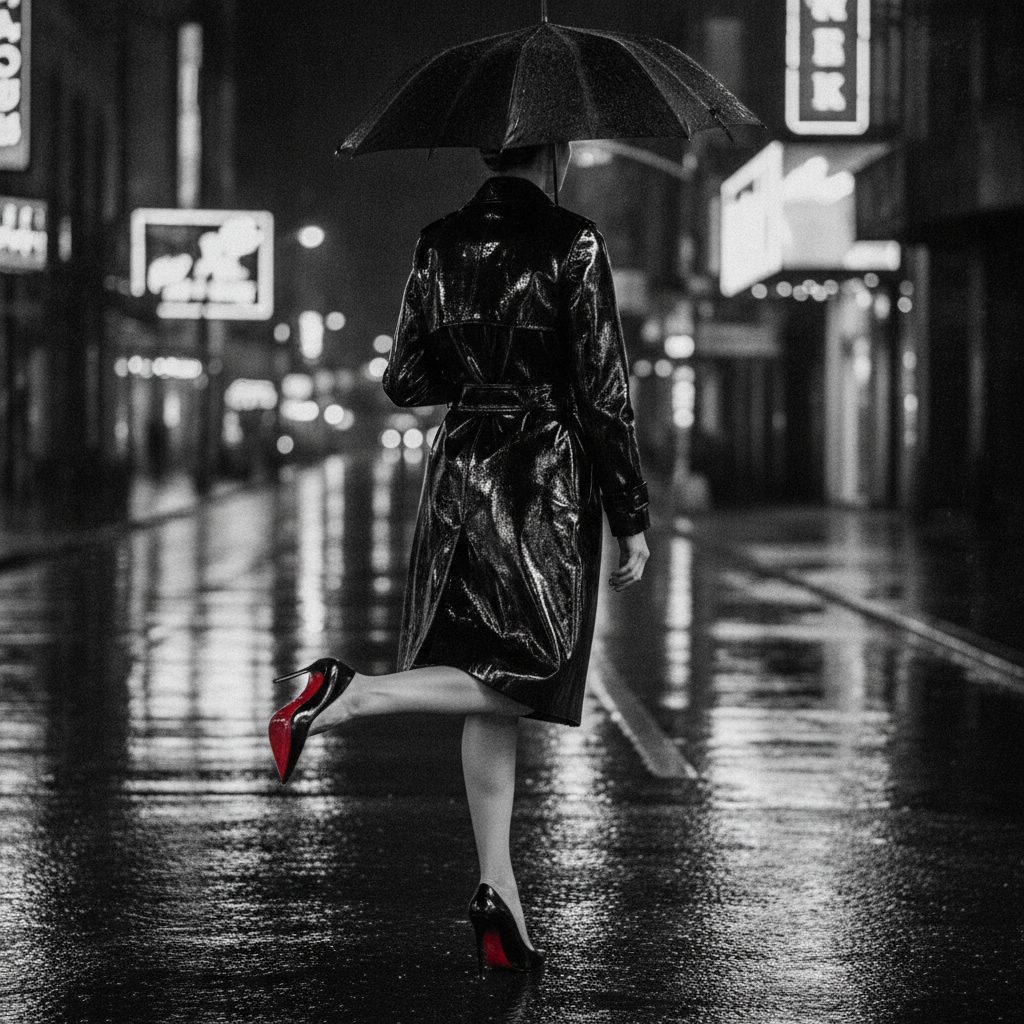
Look at a woman crossing a wet street at night and you may see almost nothing — a dark coat, a dark umbrella, the city reduced to a silhouette. Then she lifts a heel, and a single flash of lacquered red gives the whole picture away. That flash is a trademark. It belongs to Christian Louboutin, and the story of how it got there is one of the great accidents in design.
A borrowed bottle of nail polish
The year was 1992. Louboutin, then a young Paris designer, was staring at a prototype based on Andy Warhol's Flowers and feeling that something was dead about it. The shoe looked heavy; the black sole "killed" the drawing. As he tells it, he glanced over at an assistant painting her nails in bright red, grabbed the bottle, and painted the sole by hand. The effect was instant — the shoe suddenly had a pulse. He kept it.
What began as a fix became the entire brand. Every pair since has carried the same glossy scarlet underside, and it is the reason a shoe seen only from behind, or in shadow, is still unmistakably a Louboutin. The design lives in the one place you are not supposed to look.
The black hides the shoe. The red gives it away. That is the whole trick of a silhouette with a signature.
Two tones, one contour
There is a reason the red sole belongs in a journal about silhouettes. A Louboutin, photographed in the high-contrast style of these images, is a study in exactly the two-tone grammar we keep returning to: a body reduced to black, a ground reduced to grey, and a single deliberate accent that tells your eye where to land. Strip the colour and you have a shadow. Add one red note and the shadow acquires an identity. It is negative space with a punchline.
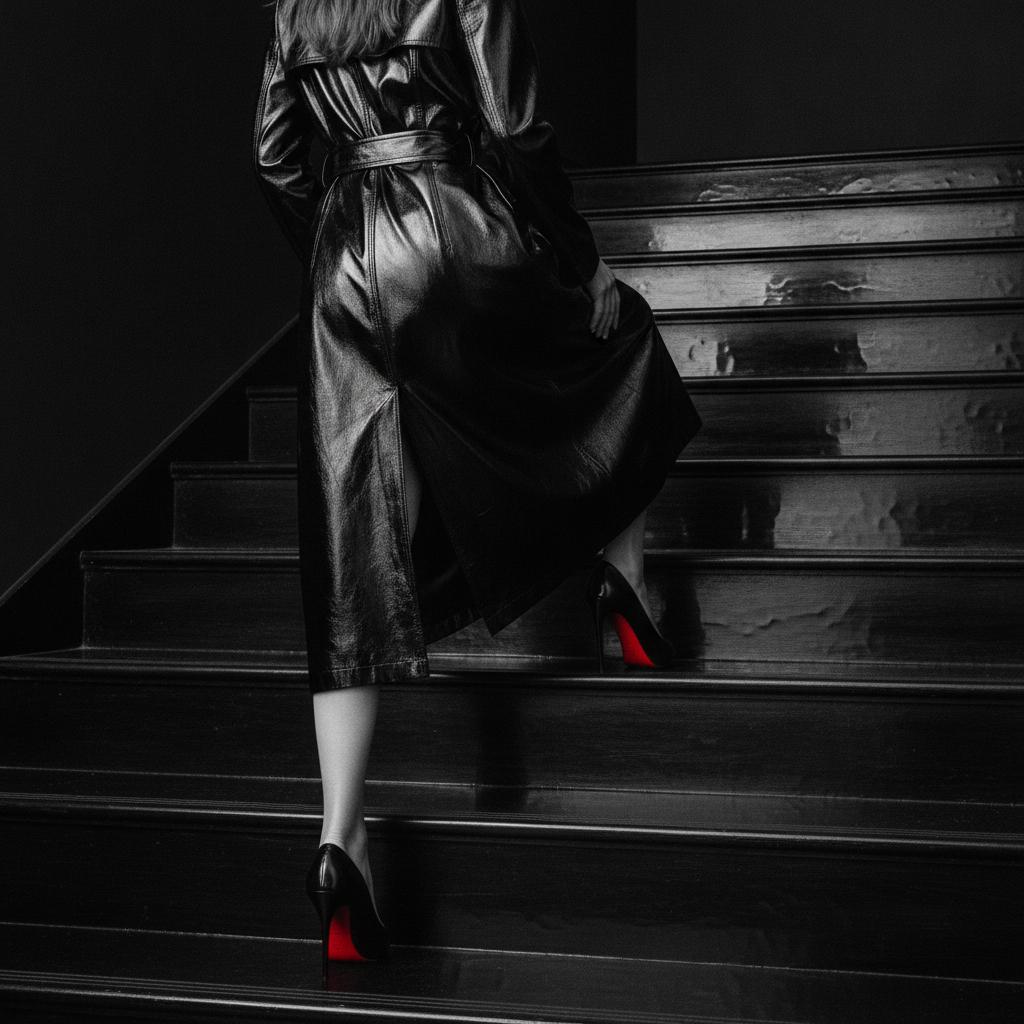
Photographers have understood this for a century — the technique of leaving an image monochrome except for one saturated element is called colour isolation, and it works on precisely the instinct Louboutin stumbled into. The eye cannot ignore a lone warm colour in a cold, dark field. It reads as heat, as blood, as danger, as glamour. He simply put that instinct on the sole of a shoe.
The colour that went to court
By 2008 the red sole was valuable enough to defend. Louboutin registered it as a trademark in the United States — not a shape, not a logo, but a colour in a specific place: a lacquered red on the outsole, officially matched to Pantone 18-1663 TPG, "Chinese Red." Very few colours in the world are legally owned this way. Tiffany has its blue; Louboutin has its red.
Then, in 2011, Yves Saint Laurent released an all-red shoe — red upper, red sole — and Louboutin sued. The 2012 ruling from the U.S. Second Circuit Court of Appeals is a small masterpiece of common sense: the red sole is a valid, protectable trademark, the court said, but only when it contrasts with the rest of the shoe. A red sole against a black upper? Protected. A red sole on an entirely red shoe? Fair game, because there the colour is decoration, not a signature. In other words, the law agreed with the artists: the mark only exists because of the contrast. Without the dark silhouette around it, the red means nothing.
Why it still works
Three decades on, the trick has not aged, and the reason is not fashion — it is perception. A single accent colour against black-and-white:
- Directs the eye instantly. Your visual system is wired to lock onto a lone chromatic point in a desaturated scene. You cannot not look at it.
- Reads from any angle. A logo has to face you. A silhouette-plus-accent identifies itself from behind, in the rain, in shadow, at a distance — which is exactly where these photographs catch it.
- Turns absence into presence. The shoe hides in darkness and reveals itself in one stroke of colour. That is the same paradox as the silhouette itself: leave almost everything out, and the little that remains says more.
It is worth remembering that a pair of these sells for the better part of a thousand euros, and that a great deal of that price is the colour of a part you walk on. Christian Louboutin did not invent the high heel, the stiletto, or the colour red. He simply noticed that a shadow becomes a signature the moment you give it one point of heat — and then he had the nerve to trademark it.