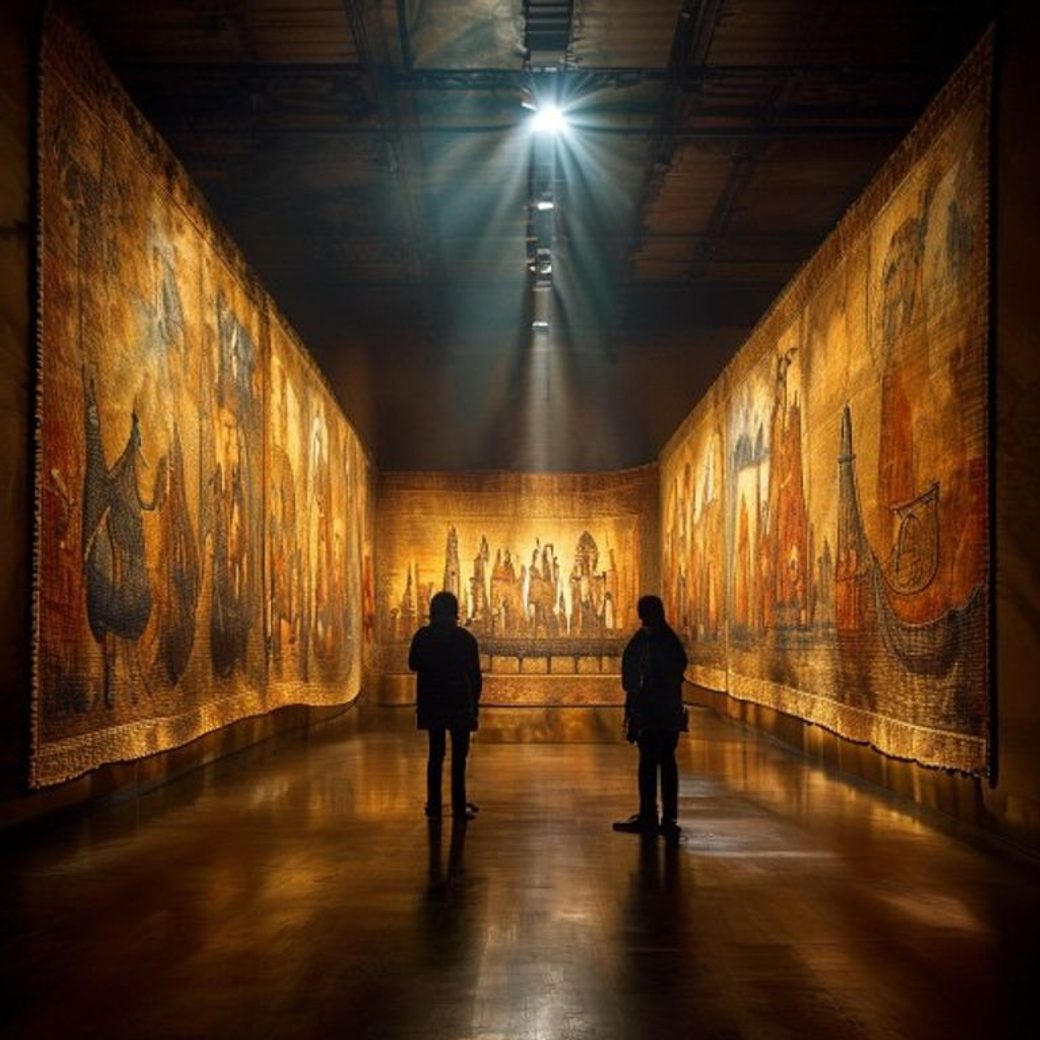
Sometime this autumn, a strip of 950-year-old linen roughly as long as three tennis courts laid end to end is going to be the hottest ticket in London. In one of the more surreal cultural events of 2026, the Bayeux Tapestry — the most famous piece of needlework on Earth — is leaving Normandy for the British Museum, its first trip across the Channel in around nine and a half centuries. Tickets for the opening months sold out almost instantly. People are queueing, in 2026, to look at embroidery.
Here's the thing nobody tells you until you actually stand in front of it: the Bayeux Tapestry isn't stuffy, and it isn't hard. It's basically a comic strip. It has action panels, running captions, a clear villain arc, gore, a spooky omen in the sky, and a punchline so famous people still misquote it a thousand years later. If you've ever followed a story told in pictures — a comic, a storyboard, a meme thread — you already know how to read it. So let's do that.
First, the pedantry: it's not a tapestry
Sorry. We have to. A real tapestry is woven — the image is built into the cloth on a loom as it's made. The Bayeux Tapestry is an embroidery: someone made the linen first, then stitched the pictures on top in coloured wool. As the Bayeux Museum patiently explains, it's about 68.3 metres long and only 70cm tall, made from nine separate linen panels embroidered in wool and then sewn together into one continuous ribbon of story. It's been called a tapestry for so long that the name stuck, which is very on-brand for the internet age: the title is technically wrong and nobody cares.
That long, skinny shape is the whole trick. You don't stand and admire it like a painting — you walk it, left to right, and the story unspools as you go. It's the exact reading experience of a comic strip or a film reel, invented centuries before either existed.
The plot, in one breath
The Tapestry tells the story of the events leading to the Norman Conquest of England in 1066. The short version: the English king Edward the Confessor dies without an obvious heir. An English nobleman, Harold Godwinson, grabs the crown — despite, the Tapestry insists, having earlier sworn an oath to support William, Duke of Normandy. William is not amused. He builds a fleet, sails over, and at the Battle of Hastings the two armies smash into each other until Harold ends up dead and William ends up king.
Crucially, this is the Norman version of events — it was almost certainly commissioned by William's half-brother, Bishop Odo of Bayeux, and probably stitched by skilled English embroiderers. So it's history written by the winners, in wool. Harold is the oath-breaker who had it coming; William is the wronged man restoring order. Every propaganda film you've ever seen is doing the same job. This one just took years and a lot of thread.
It's history written by the winners — in wool. The Bayeux Tapestry is a 68-metre argument, disguised as a picture book.
Why it reads like a comic
Look at how the thing is actually built and the comic-strip comparison stops being cute and starts being accurate. There's a main "panel" band running the full length, where the action happens. Above and below it run decorative borders stuffed with animals, mythical beasts and the occasional rude joke — the medieval equivalent of margin doodles and background gags. And stitched right into the scenes are Latin captions — Hic Harold ("Here Harold…") — captioning the action like speech bubbles or subtitles.
It is, in other words, a sequential visual narrative with text integrated into the image. That's the textbook definition of comics. The whole thing is packed with hundreds of human figures, dozens of ships and horses and a small zoo of animals, according to HISTORY — a cast of thousands, rendered in about four colours of yarn. And the storytelling is genuinely good: the embroiderers use the same visual logic we admire in modern illustration, letting shape, direction and empty space carry the drama. If you've read our piece on how negative space does the emotional heavy lifting, you'll spot it here too — the calm, sparse scenes before Hastings make the chaos of the battle hit harder.
The comet: a jump-scare from space
Every good disaster story needs an omen, and the Tapestry has a spectacular one. Just after Harold takes the throne, a crowd of terrified figures point up at a streaking star while Harold slumps on his seat, apparently receiving bad news. That star is real, and we know exactly what it was: Halley's Comet, which swung past Earth in the spring of 1066 and would have hung in the sky like a bright, unignorable warning. The comet wouldn't be scientifically understood as a returning object for another 700 years, but the embroiderers already knew a good visual metaphor when they saw one: the heavens themselves disapprove of King Harold.
It's one of the earliest recognisable depictions of Halley's Comet in Western art, and it's still doing its job — your eye goes straight to it. Medieval storytellers understood dramatic irony perfectly well. The audience knows the comet means doom; poor Harold, on screen, is only starting to sweat.
About that arrow in the eye…
Here is the most famous "fact" about the Bayeux Tapestry, and it might be wrong. Ask anyone how Harold died and they'll mime an arrow to the eye. It's one of history's great gruesome images. The problem is that it may be a later edit.
As Thames & Hudson lays out, the earliest careful drawings of the Tapestry, made in the 1720s, show only a row of stitch holes above the figure labelled Harold — no clear arrow. A prominent arrow appears in a drawing from around 1817, and later restorers, who knew the legend, may have "restored" the arrow into the cloth to match the story everyone expected. In other words, the most iconic moment in the whole work might be a case of a myth reshaping the very evidence for it. Which figure is even "Harold" is debated too — there are two candidates in that final scrum, and scholars still argue about it.
That uncertainty isn't a flaw; it's what makes it art rather than a photograph. The Tapestry doesn't hand you a clean fact. It hands you an image so strong that people have been fighting over what it means for centuries — including by re-stitching it.
The missing ending — the ultimate cliffhanger
And then it just… stops. The Tapestry as we have it ends abruptly with English soldiers fleeing Hastings. Scholars estimate that roughly three metres of the original is lost, and that the missing finale almost certainly showed the payoff: William's coronation as King of England on Christmas Day, 1066. The whole 68-metre argument was building to that shot, and it's the one panel we don't have. Every so often there's fresh drama about the gap — in recent years a small fragment believed to be from the Tapestry turned up in a German archive, and France has commissioned an artist to imagine the lost ending. It is, quite literally, a cliffhanger 950 years in the making.
The original viral content
If all of this sounds suspiciously modern, that's because the Bayeux Tapestry has quietly become an internet-native object. In 2003 two German artists built the "Historic Tale Construction Kit," a little tool that lets anyone drag medieval figures onto aged linen and add their own captions — and people immediately used it to render modern life, from office meetings to memes, in full Bayeux style. It went viral, died, and was rebuilt and revived years later by fans. A thousand-year-old piece of Norman propaganda is now a meme format.
That's the real reason it still lands. The Bayeux Tapestry does exactly what today's most-shared images do: it turns a messy political event into a simple, striking, walkable story with a hero, a villain, an omen and a killer ending — and it lets the framing do the persuading. It's the same trick we keep bumping into on this site, whether it's a banana taped to a wall or any other object we're told to take seriously: the story around the thing does most of the work. And if you want to get better at spotting that story in any image — old or new — our guide to reading a picture like a critic is a good next stop.
So when the crowds file past it in London this winter, they won't really be looking at old cloth. They'll be reading the world's first blockbuster comic — one that has survived fire, theft, a Nazi obsession, restorers with agendas, and nearly a millennium of misquotes, and is still, somehow, the best story in the room.
Quick questions
Is it really not a tapestry? Correct — it's an embroidery. The pictures were stitched in wool onto a finished linen backing, not woven into the cloth. The name is a historical accident that stuck.
Did Harold actually take an arrow to the eye? Nobody's sure. The famous arrow may have been added by later drawings and restorers rather than the original stitchers, and even which figure is Harold is debated.
How do I see it in 2026? It's at the British Museum from 10 September 2026 to 11 July 2027. Opening months sold out fast; check the museum for later ticket releases. Its permanent home is the Bayeux Museum in Normandy.