What Is Neo-Noir Art?
Neo-noir art is contemporary painting, photography, illustration and digital art that borrows the visual language of film noir: hard shadow, night streets, rain, isolated figures and a mood of moral unease. It is not a formal movement with a manifesto but an aesthetic carried from cinema into the visual arts, usually in black and white, low-key colour or a single accent colour such as red.
Where the word comes from
Film noir is French for “black” or “dark film”. The critic Nino Frank applied it to American crime films in an article in L’Écran français in August 1946, after films such as The Maltese Falcon and Laura reached Paris at the end of the war. The classic cycle ran through the 1940s and 1950s, and its low-key, black-and-white look has roots in German Expressionist cinema.
Neo means new. From the 1970s critics used neo-noir for films that brought noir’s themes and look back with a modern sensibility, among them Chinatown (1974), Taxi Driver (1976), Blade Runner (1982) and Blue Velvet (1986). Sin City (2005), adapted from Frank Miller’s comics, pushed the style back to stark black and white with only a few isolated spots of colour.
The visual arts borrowed the term later and more loosely. On a gallery label or in a print shop, “neo-noir art” usually means a picture that could be a still from one of those films.
The traffic ran both ways
Noir did not invent its look from nothing. Edward Hopper’s night scenes, above all Nighthawks (1942), are routinely cited as a visual source for the genre, and his House by the Railroad (1925), now at the Museum of Modern Art, is widely credited as a model for the Bates house in Hitchcock’s Psycho (1960).
Photographers had found the night city too. Brassaï photographed Paris after dark in the early 1930s, and Weegee’s flash-lit crime pictures of New York were collected in Naked City (1945), whose title was reused for the 1948 film. Behind all of them sits chiaroscuro, the hard modelling in light and dark that Caravaggio made famous around 1600. Neo-noir art is that inheritance coming back from the screen to the wall.
Seven traits of neo-noir art
- Low-key light and hard shadow. Most of the frame is dark and the light comes from one source: a streetlamp, a window, a sign. Cast shadows and the stripes of a blind do much of the drawing.
- Night, rain and reflective surfaces. Wet asphalt, puddles, glass and lacquer double the light and the figures in it.
- The isolated figure. A woman on a staircase, a man under a lamp, a body seen from behind or only in part. Faces are often hidden, which is where noir meets silhouette art.
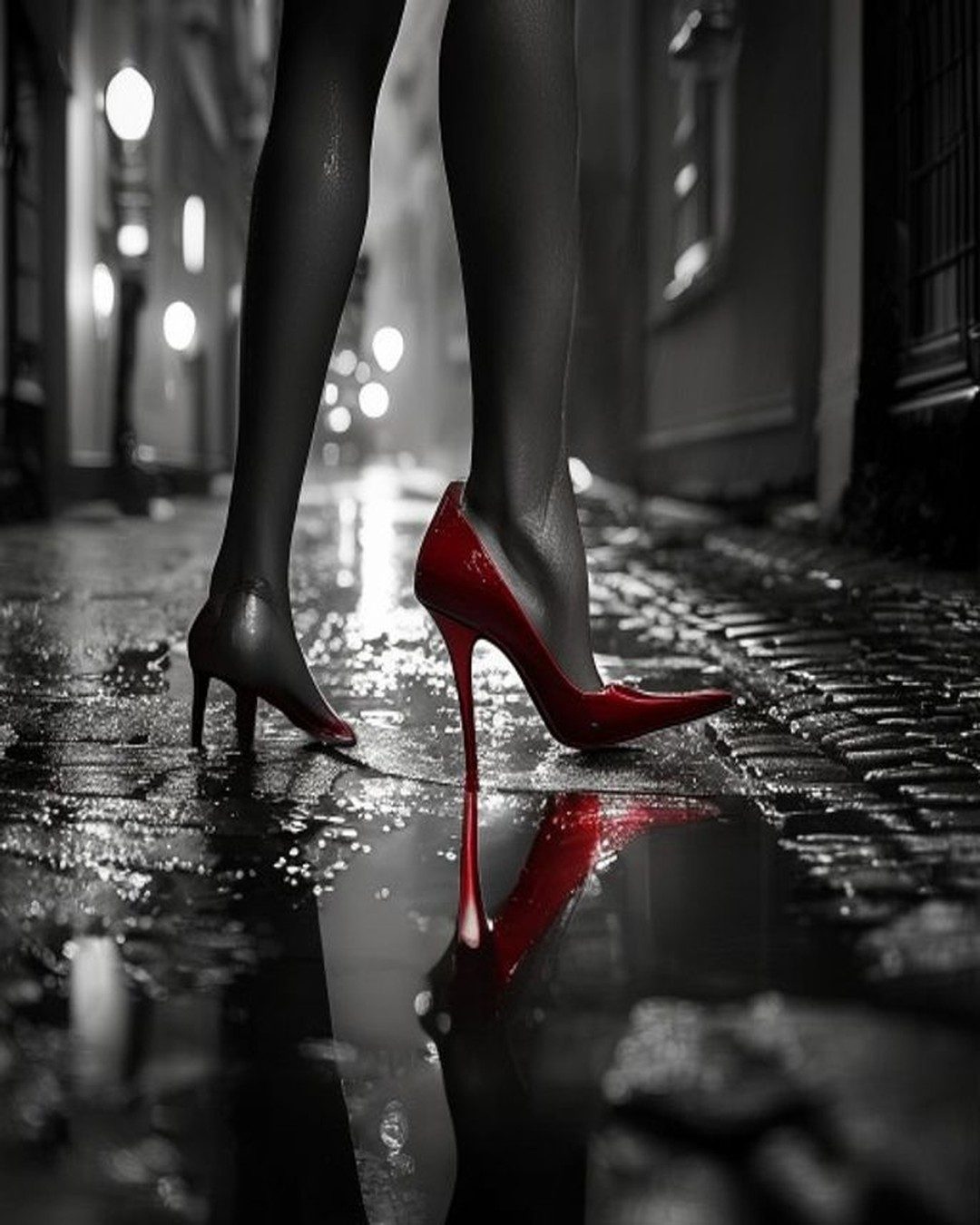
- A restricted palette. Black and white, blue-black, sodium orange, or a single saturated accent, most often red. The single accent is colour isolation, and noir is where it feels most at home.
- Frames within frames. Doorways, windows, stair rails and mirrors, often seen from steep or tilted angles.
- Glamour under threat. Evening dress, heels, smoke and patent leather, and the stock figures of the femme fatale and the private eye.
- A story without an ending. The picture suggests that something has just happened or is about to, and withholds which.
Film noir, neo-noir, neon noir and neo-noir art
| Term | What it means | Typical look |
|---|---|---|
| Film noir | American crime films of the 1940s and 1950s, named by French critics | Black and white, low-key light, hard shadow |
| Neo-noir | Films from the 1970s on that revive noir’s themes | Colour or black and white, modern settings |
| Neon noir | An informal label for neo-noir lit by city neon | Magenta and cyan light, wet reflections |
| Neo-noir art | Paintings, photographs, prints and digital works in that visual language | Shadow, night, rain, often one accent colour |
Artists associated with the noir look
- Edward Hopper (1882–1967): lone figures and night cities; the painter most often named as a source for noir.
- Weegee (Arthur Fellig, 1899–1968): flash-lit crime and street photographs of New York.
- Gregory Crewdson (born 1962): staged, cinematic photographs of small-town America, lit and produced like film sets.
- Frank Miller (born 1957): the Sin City comics, drawn in pure black and white with occasional spot colour.
- Valerie Corvin: an emerging Neo-Noir artist working in mixed media, whose series Red on Noir keeps a single red accent in otherwise black-and-white night scenes. Disclosure: Valerie Corvin founded Art Silhouette, so this is our own founder’s work.
Collecting and hanging neo-noir art
Neo-noir works depend on deep blacks, so print quality matters more than size: look for a stated edition, archival paper and a matte or lightly textured surface that keeps reflections down. Hang them where the light can be controlled; a single warm picture light suits the subject better than a bright, even wash. To check the size before you buy, use the wall art size calculator.
Frequently asked questions
What is neo-noir art?
Neo-noir art is contemporary painting, photography, illustration and digital art that borrows the visual language of film noir: hard shadow, night streets, rain, isolated figures and a mood of moral unease. It is not a formal movement with a manifesto but an aesthetic carried from cinema into the visual arts, usually in black and white, low-key colour or a single accent colour such as red.
Is neo-noir an art movement?
No. Neo-noir art has no founding group, manifesto or fixed dates. It is an aesthetic carried over from cinema, used by painters, photographers, illustrators and digital artists who borrow film noir’s light, settings and mood.
What is the difference between noir and neo-noir?
Film noir names American crime films of the 1940s and 1950s. Neo-noir names later films, from the 1970s on, that revive noir’s themes and look with a modern sensibility. In the visual arts, neo-noir is used for contemporary work in the same visual language.
What colours are used in neo-noir art?
Mostly black, white and deep shadow, sometimes with blue-black or sodium-orange city light. Many neo-noir works keep one saturated accent, most often red, so the eye goes straight to it.
Who are neo-noir artists?
Edward Hopper and the photographer Weegee are often named as precursors of the noir look. Later artists associated with it include the photographer Gregory Crewdson and the comics artist Frank Miller, and emerging artists such as Valerie Corvin, whose Red on Noir series is built on a single red accent.
What is Red on Noir?
Red on Noir is a series of Neo-Noir mixed-media works by Valerie Corvin, in deep black and white with a single red accent, usually the sole of a heel.
Sources
- Britannica: neo-noir
- Nino Frank and the term “film noir” (L’Écran français, August 1946)
- MoMA: Edward Hopper, House by the Railroad (1925)
- Sin City, the comics by Frank Miller
Written by Valerie Corvin, founder and editor of Art Silhouette and creator of Red on Noir. Because her own work appears in this guide, it is labelled as such. Last reviewed November 14, 2026.